
Barite (barium sulfate, BaSO₄) is a critical non-metallic mineral, frequently occurring in massive veins, bedded deposits, or as a gangue mineral alongside limestone, sandstone, and sulfide ores. Due to decades of aggressive mining, high-grade, direct-shipping barite ores are becoming exceedingly rare. Today, most run-of-mine (ROM) barite has a low raw grade and must undergo rigorous beneficiation to meet stringent commercial market specifications.
The vast majority of beneficiated barite is consumed by the oil and gas industry as a weighting agent in rotary drilling fluids. To function effectively as "heavy mud" and maintain uniform viscosity under extreme downhole pressures, the final barite concentrate must adhere to strict technical standards:
API Specifications for Drilling Mud Barite
- Specific Gravity (SG): Minimum 4.30 (Requires a BaSO₄ content exceeding 90%).
- Fineness: 98% of the material must pass a 200-mesh screen, with 90%–95% passing a 325-mesh screen.
- Viscosity: Maximum allowable viscosity is 60 centipoise (cP). Mud density typically operates around 16 lbs/gallon.
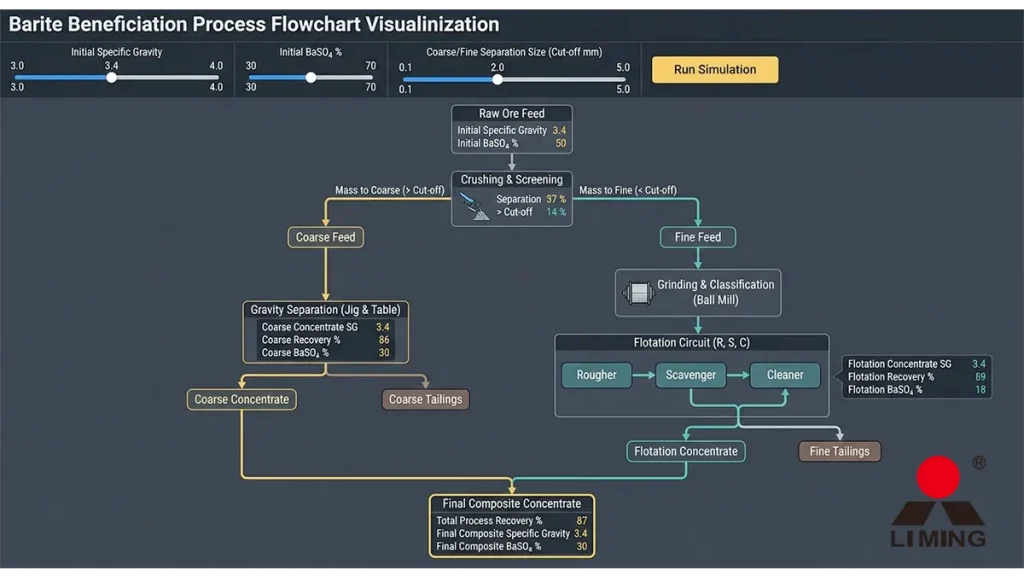
Core Barite Beneficiation Methods
The beneficiation method we select is entirely dependent on the ore's geological genesis, associated gangue minerals, and dissemination size. Barite processing generally falls into four main categories:
| Separation Method | Working Principle | Ideal Application |
|---|---|---|
| Hand Sorting | Visual differentiation based on color and density. | Extracting high-grade lump barite from coarse ROM ore. |
| Gravity Separation | Exploits the high specific gravity difference between barite (4.3-4.5) and quartz/calcite gangue (2.6-2.7). | Involves washing, desliming, jigging, and shaking tables. Highly effective for residual-type barite ores. |
| Flotation | Relies on the differences in surface physical and chemical properties. | Mandatory for sedimentary and hydrothermal ores where barite is intimately symbiotic with sulfides (galena, sphalerite) or fluorite. |
| Magnetic Separation | Utilizes magnetic susceptibility differences. | Used primarily to remove iron oxide impurities to meet the brightness/whiteness requirements for the paint and chemical industries. |
Barite Beneficiation Plant Flow Charts by Ore Type
Because no two deposits are identical, metallurgical engineers design specific flow charts tailored to the mineralogy. Here is how we approach the three most common barite deposit types.
1. Residual Barite Ore (Gravity Separation Flow Chart)
Residual ores are the most economical to process. The barite exists as nodules or lumps within a clay matrix. The primary challenge is removing the sticky clay without losing fine barite. The process is straightforward: washing, crushing, screening, and jigging.
Process Flow: ROM Ore → Primary Crushing → Washing & Trommel Screening → Desliming → Secondary Crushing → Sizing → Jigging → Concentrate Dewatering.
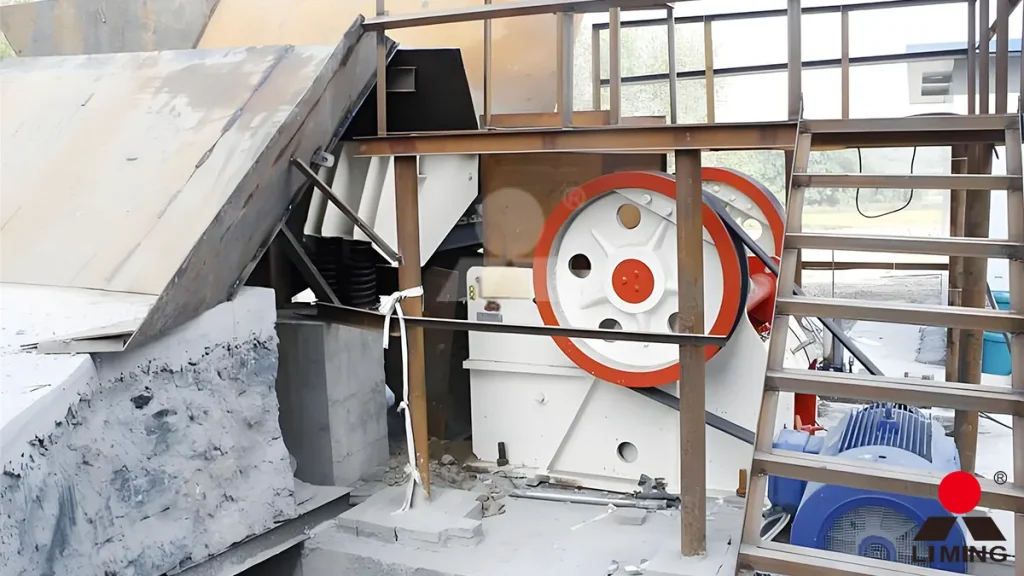
2. Sedimentary Barite Ore (Gravity + Flotation Flow Chart)
Sedimentary barite is often fine-grained and associated with silica, pyrite, and other sulfides. Gravity separation alone cannot achieve the required 4.3 SG. Therefore, a hybrid approach is used: gravity separation removes the bulk of the coarse silica gangue, and flotation is used to recover the finely disseminated barite.
Process Flow: Coarse Crushing → Fine Crushing → Screening → Jigging (pre-concentration) → Ball Mill Grinding → Hydrocyclone Classification → Fine Flotation (Rougher, Cleaner, Scavenger) → Thickening & Filtration.
3. Hydrothermal Barite Ore (Flotation Flow Chart)
Hydrothermal veins contain barite tightly interlocked with fluorite, quartz, and metallic sulfides. These ores require direct flotation. We add specific depressants in a weakly alkaline environment to inhibit gangue minerals, followed by collectors to float the barite.
Process Flow: Two-Stage Crushing → Grinding (Ball Mill) → Classification → Flotation Circuit → Concentrate Dewatering.
Deep Dive: 80 TPH Barite Gravity Separation Plant Design
To illustrate a real-world commercial application, let’s examine an 80 Tons Per Hour (TPH) barite gravity separation plant we recently engineered. The client’s deposit was a coarse-grained residual ore. By utilizing a highly optimized crushing and jigging circuit, we completely avoided the high CAPEX and OPEX associated with a flotation plant.
Stage 1: Crushing & Sizing
Barite is highly friable (brittle). If you over-crush it, you generate too much "slime" (micro-fines), which is easily lost during gravity separation. Therefore, precise, controlled crushing is mandatory.
- Primary Crushing: The raw ore is fed via a heavy-duty GZD-960×3800 Vibrating Feeder (capacity 90-160 t/h) into a Liming PE600×900 Jaw Crusher. Operating with a 75kW motor, this crusher handles feed sizes up to 500mm and easily processes 60-130 t/h, providing ample buffer for an 80 TPH plant.
- Secondary Crushing: The primary discharge is conveyed to a PF1010 Impact Crusher. Why an impactor? It utilizes a 75kW motor and produces an excellent cubic particle shape (vital for jigging efficiency) with a capacity of 50-90 t/h.
- Screening: The crushed material is fed onto a 2YZS1548 Vibrating Screen (double-deck). The screen classifies the ore into strict size fractions. Oversize (+30mm) is sent back to the PF1010. The perfectly sized fractions (10-30mm and 0-10mm) are routed to buffer silos.
Stage 2: Buffering (Surge Control)
Jigging machines rely on fluid dynamics. If the feed rate fluctuates, the mineral bed destabilizes, ruining the separation efficiency. We installed multiple 15m³ and 25m³ surge bins equipped with electromagnetic vibrating feeders beneath the screens. This ensures a perfectly uniform flow of ore into the jigs.
Stage 3: Jigging (Gravity Separation)
The core of the plant. Jigging utilizes a vertical, alternating pulse of water. The heavy barite settles rapidly to the bottom of the jig bed, while the lighter gangue is pushed to the upper layer and discharged as tailings.
- Coarse Fraction (10-30mm): Fed into four AM30 large-particle jigs.
- Fine Fraction (0-10mm): Fed into a specialized 2LTC-6109/8T trapezoidal jig designed to recover fine heavy minerals.
80 TPH Core Equipment Configuration List
| Equipment Category | Recommended Model (Liming DB) | Quantity | Technical Note |
|---|---|---|---|
| Vibrating Feeder | GZD-960×3800 | 1 | 90-160 t/h, 11kW motor |
| Primary Jaw Crusher | PE600×900 | 1 | Max feed 500mm, 75kW motor |
| Secondary Impact Crusher | PF1010 | 1 | 50-90 t/h, excellent particle shaping |
| Vibrating Screen | 2YZS1548 | 1 | 15kW, double-deck for strict sizing |
| Coarse Jig | AM30 | 4 | Processes 10-30mm fraction |
| Fine Jig | 2LTC-6109/8T | 1 | Processes 0-10mm fraction |
| Belt Conveyors | B6X-Width-800 / 650 | Set | Customized based on site topography |
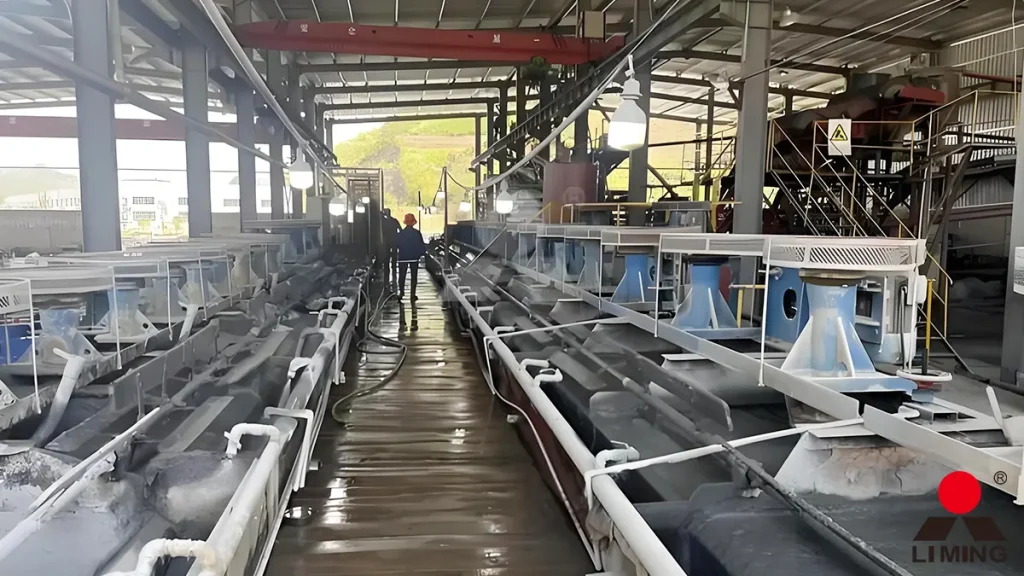
The Flotation Alternative: Processing Complex Ores
If your deposit contains finely disseminated barite mixed with fluorite and sphalerite (zinc), a gravity plant will fail. You must use flotation. Here is a brief overview of how a typical commercial flotation circuit operates:
1. Grinding and Classification
The crushed ore is fed into a steel-head Ball Mill operating in a closed circuit with a Hydrocyclone (or spiral classifier). The goal is to grind the material until it reaches the liberation size (typically 100–150 mesh). The cyclone overflow (particles smaller than 200 mesh at approx. 20% solids) moves to the conditioning tanks. Coarse underflow is sent back to the mill.
2. Conditioning and Reagents
In the conditioning tanks, the pH is adjusted to 8.0–10.0 using sodium hydroxide (caustic soda) or sodium carbonate. Sodium silicate is often added to disperse slimes and depress quartz/silicates. For the collector, refined tall oil fatty acids (oleic acid) or petroleum sulfonates are added to make the barite hydrophobic (water-repelling).
3. The Flotation Circuit
The conditioned slurry enters a bank of mechanical flotation cells (e.g., Sub-A type). The rougher cells pull the bulk of the barite into a froth. This froth is then cascaded through two to three stages of cleaner cells to upgrade the purity. The tailings from the cleaner cells are recirculated, while final tailings are pumped to a thickener.
4. Thickening and Filtration
The final high-grade barite froth is pumped to a rake thickener to remove excess water. The thickened underflow is filtered using a rotary disc vacuum filter, producing a damp cake. Finally, a rotary dryer removes the remaining moisture, and the powder is conveyed to silos for bagging.
Expert Conclusion
Designing a barite beneficiation plant is an exercise in balancing capital expenditure (CAPEX) with metallurgical recovery. Before procuring any equipment—whether it's a PE600x900 Jaw Crusher or a bank of flotation cells—it is imperative to conduct a comprehensive bulk sample test. Understanding the liberation size, the specific gravity differential, and the clay content of your specific ore will dictate the entire flow chart.
As the industry moves toward processing deeper, lower-grade deposits, utilizing high-efficiency, large-scale crushing and screening equipment is no longer optional; it is the only way to maintain profitability. If you are looking to optimize an existing plant or design a new barite processing facility, aligning with proven engineering principles and robust equipment will ensure you meet API drilling mud specifications every single time.