
Base metals like copper, lead, and zinc are the backbone of modern industrial infrastructure, electronics, and construction. However, as high-grade, easily accessible deposits are depleted, the mining industry is forced to process increasingly complex, low-grade, and finely disseminated ores. Making the extraction of these base metals profitable requires an incredibly efficient, highly optimized mineral processing plant.
From traditional multi-stage crushing and flotation circuits for sulfide ores to advanced hydrometallurgical leaching for oxide ores, the equipment selected dictates the plant's capital expenditure (CAPEX), operating expenditure (OPEX), and overall metal recovery. This guide breaks down the core processing stages and the heavy-duty equipment required to process base metal ores.
1. The Crushing Circuit: "Crush More, Grind Less"
Comminution (size reduction) is notoriously energy-intensive, often accounting for 40% to 70% of a processing plant’s total power consumption. To mitigate this, modern plants adhere to the "crush more, grind less" philosophy. The goal is to reduce the run-of-mine (ROM) ore (often >500mm) down to an optimal feed size for the mills (typically <15mm) using highly efficient crushers.
Primary Crushing
For hard, abrasive sulfide ores, the Jaw Crusher is the undisputed standard. Utilizing a simple but powerful squeezing motion between a fixed and moving jaw plate, heavy-duty jaw crushers (like the C6X series) can easily handle massive boulders, reducing them to 50–200mm. They are usually fed by heavy-duty apron feeders or vibrating feeders to prevent sudden surges.
Secondary and Tertiary Crushing
The primary discharge is conveyed to secondary and tertiary crushers operating in a closed circuit with vibrating screens.
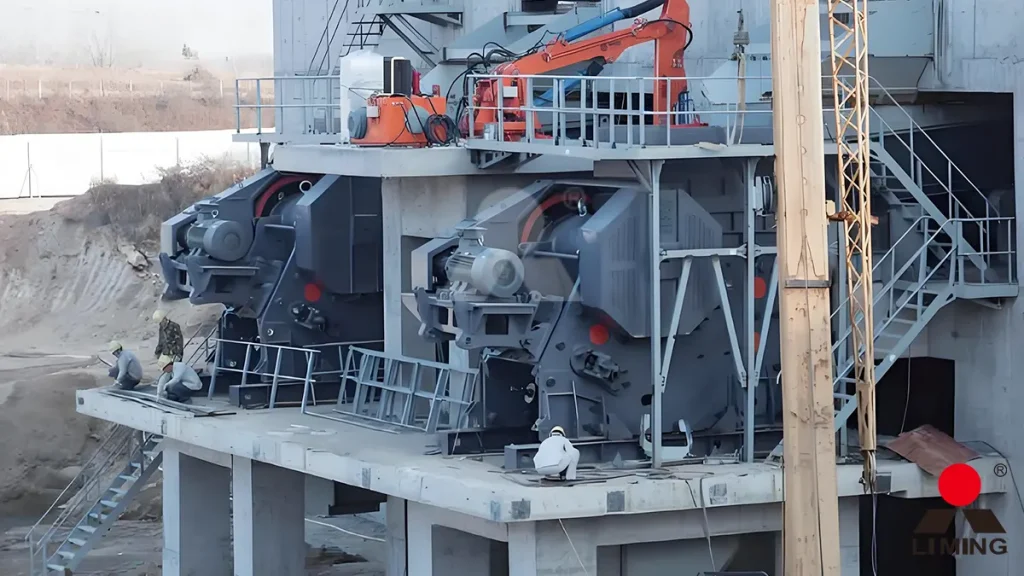
- Cone Crushers: Operating on a lamination crushing principle, cone crushers (like the HPT Multi-Cylinder series) are ideal for hard rock. They deliver immense crushing force and a highly uniform product shape while experiencing minimal wear on the liners.
- Impact Crushers: If the base metal ore is of medium hardness, impact crushers can be utilized. They offer a massive crushing ratio and excellent cubic particle shape but require more frequent blow bar replacements if the silica content is high.
2. The Grinding and Classification Circuit
Grinding is where physical liberation occurs—separating the valuable copper or lead minerals from the barren gangue (waste rock). Because grinding consumes the vast majority of the plant's power and maintenance budget (liner and media wear), selecting the right milling technology is paramount.
Traditional Ball Mill Circuits
The standard setup involves a two-stage process: a primary Grate-discharge Ball Mill (or Rod Mill) for coarse grinding, followed by an Overflow-type Ball Mill for fine grinding. These mills operate in a closed circuit with classification equipment.
- Spiral Classifiers: Used primarily in coarse grinding circuits. They utilize a rotating screw to push coarse, unliberated particles (sand) back into the mill, while the fine, liberated particles flow over the weir.
- Hydrocyclones: The modern standard for fine classification. Using centrifugal force, cyclones efficiently separate fine particles (e.g., -400 mesh) and send them to the flotation circuit, while returning the coarse underflow to the mill. They have a massive processing capacity and a tiny footprint compared to spiral classifiers.
Semi-Autogenous Grinding (SAG) Mills
For large-scale operations (e.g., >5000 tons per day), the SAG mill has revolutionized comminution. Instead of relying entirely on steel balls, a SAG mill uses large pieces of the ore itself as the grinding media (supplemented by a small percentage of steel balls). Often arranged in a SABC circuit (SAG mill + Ball mill + Cone crusher), this technology eliminates the need for secondary and tertiary crushing stages entirely, drastically reducing the plant footprint and simplifying maintenance.
3. The Separation Stage: Flotation vs. Hydrometallurgy
Once the ore is liberated, the valuable metals must be separated. The method chosen depends entirely on the mineralogy: sulfide ores are floated, while oxide ores are leached.
Froth Flotation (For Sulfide Ores)
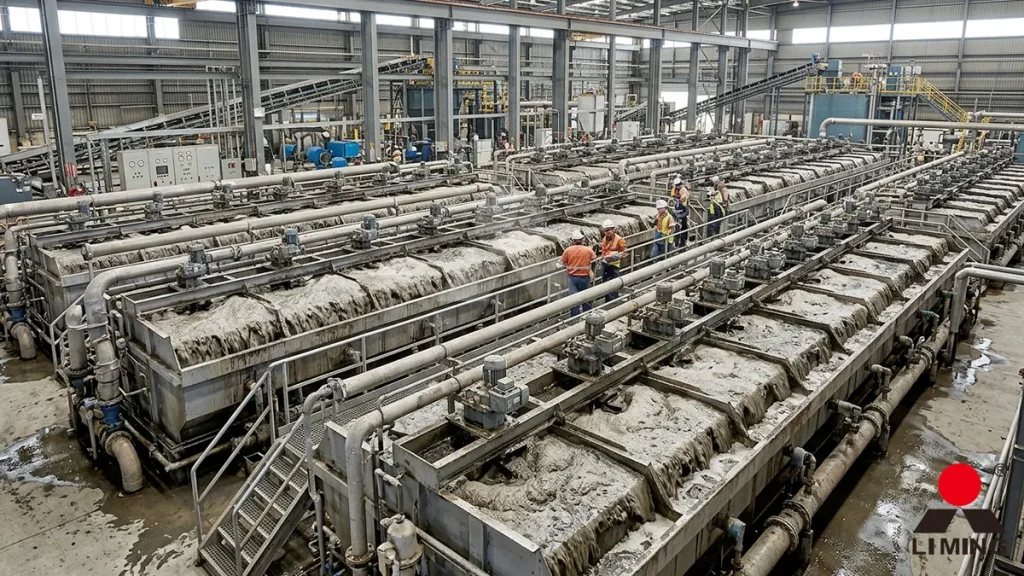
Flotation is the standard for copper, lead, and zinc sulfides. The finely ground slurry is mixed with reagents (collectors, frothers, and modifiers) in conditioning tanks. The collectors selectively coat the target minerals, making them hydrophobic (water-repellent).
In mechanical or pneumatic Flotation Cells, air is introduced, creating bubbles. The hydrophobic metal sulfides attach to the bubbles and rise to the surface, forming a mineral-rich froth that is skimmed off as concentrate. For complex polymetallic ores (e.g., Copper-Lead-Zinc), engineers use differential flotation—floating one metal first (e.g., copper), then depressing it to float the next (e.g., lead), and so on.
*Note: In many circuits, a Unit Flotation Cell or Mineral Jig is placed directly between the ball mill and the classifier. This rapidly recovers coarse, fast-floating minerals (or native metals) before they are overground in the mill, improving overall recovery efficiency.
Hydrometallurgy (For Oxide Ores)
Copper oxide ores respond poorly to standard flotation. Instead, they are processed using Solvent Extraction and Electrowinning (SX-EW).
- Leaching: The ore is crushed and piled on impermeable pads (Heap Leaching) or placed in large vats (Agitation Leaching). A weak sulfuric acid solution is applied, dissolving the copper into a pregnant leach solution (PLS).
- Solvent Extraction (SX): The PLS is mixed with an organic extractant that selectively binds to the copper ions, separating them from impurities.
- Electrowinning (EW): The pure copper solution is passed through an electrolytic cell, where pure copper metal (99.99%) plates onto cathodes.
4. Dewatering and Automation
The final stages of a base metal plant involve preparing the concentrate for transport and safely managing the waste.
Concentrate and Tailings Dewatering
The froth concentrate contains a massive amount of water. It is pumped into high-rate Thickeners, where flocculants help the solids settle rapidly. The thickened slurry is then processed through a Filter Press or Vacuum Filter, reducing the moisture content to below 12% for safe transport to smelters. Tailings are similarly dewatered, allowing the plant to recycle process water and utilize dry-stack tailings storage, which is far safer and more environmentally friendly than traditional wet tailings dams.
Real-Time Analysis and Automation
To keep a base metal plant profitable, operators can no longer rely on manual sampling. Modern plants utilize automated X-ray Diffraction (XRD), Near-Infrared (NIR) spectroscopy, and Prompt Gamma Neutron Activation Analysis (PGNAA) directly on the conveyor belts and flotation lines. This allows plant managers to monitor ore grades, adjust grinding sizes, and fine-tune flotation reagent dosing in real-time, preventing chemical waste and maximizing metal recovery.
Conclusion: Designing the Optimal Plant
There is no "one-size-fits-all" base metal processing plant. The flowsheet and equipment selection must be rigorously tailored to the ore's mineralogy, hardness, and dissemination size.
Whether you are designing a high-tonnage SAG mill circuit for a low-grade porphyry copper deposit or a highly selective differential flotation circuit for a complex lead-zinc ore, success requires comprehensive metallurgical testing and the integration of highly reliable, energy-efficient equipment. By combining robust physical comminution with advanced chemical separation and real-time automation, modern processing plants can turn even the most marginal base metal deposits into highly profitable operations.