
In modern mineral processing, the extraction of gold from complex, low-grade, or refractory ores requires highly efficient metallurgical strategies. Among these, the Froth Flotation Process stands out as the most widely utilized and cost-effective method for concentrating gold-bearing sulfide minerals. By maximizing the enrichment of gold into a high-grade sulfide concentrate, flotation drastically reduces the volume of material that must undergo expensive downstream hydrometallurgical or pyrometallurgical treatments.
Today, approximately 80% of primary rock gold is processed using flotation-based circuits. It is the definitive process for highly floatable gold-bearing quartz vein ores, polymetallic gold-sulfide ores, and carbonaceous ores. Furthermore, flotation is routinely employed to remove interfering impurities (such as copper or carbon) prior to cyanidation.
This comprehensive guide delves into the engineering principles of gold flotation, analyzes various process flowsheets, and explores how flotation is combined with other extraction methods to maximize gold recovery.
1. The Fundamental Principles of Gold Flotation
The flotation process exploits the differences in the physicochemical surface properties of various minerals. It does not rely on density differences like gravity separation, but rather on hydrophobicity—the tendency of a mineral to repel water and attach to air bubbles.
The Mechanics of Froth Flotation
After the gold ore is finely ground to liberate the valuable mineral particles from the gangue (waste rock), the resulting slurry (pulp) is fed into a flotation cell. The process unfolds in several precise thermodynamic and hydrodynamic steps:
- Reagent Conditioning: Collectors, frothers, and modifiers (such as lime for pH control) are added. The collectors selectively adsorb onto the surface of the gold-bearing sulfide minerals, rendering them highly hydrophobic.
- Aeration and Agitation: An impeller violently agitates the pulp while air is injected into the bottom of the cell. The frother stabilizes the resulting air bubbles.
- Bubble Attachment: Due to turbulent fluid dynamics, the hydrophobic gold-sulfide particles collide with and permanently attach to the rising air bubbles. The hydrophilic (water-loving) gangue minerals remain suspended in the pulp.
- Froth Recovery: The mineral-laden bubbles rise to the surface, forming a dense, metallic-colored froth layer. Mechanical scrapers continuously push this froth over the lip of the cell to be collected as gold concentrate. The remaining pulp exits the cell as tailings.
2. The Standard Gold Flotation Process Flow
A successful gold flotation plant is a continuous, carefully balanced loop of size reduction and chemical separation. A typical standalone flotation flowsheet consists of the following stages:
Stage 1: Crushing and Screening
Run-of-mine (ROM) gold ore must be reduced to a manageable size. Plants typically utilize a two-stage or three-stage closed-circuit crushing setup. The primary reduction is handled by heavy-duty Jaw Crushers, followed by secondary reduction using Cone Crushers or Impact Crushers. Vibrating screens ensure that only ore below a specific threshold (e.g., -15mm) advances to the milling circuit, preventing the mills from being overworked.
Stage 2: Grinding and Classification
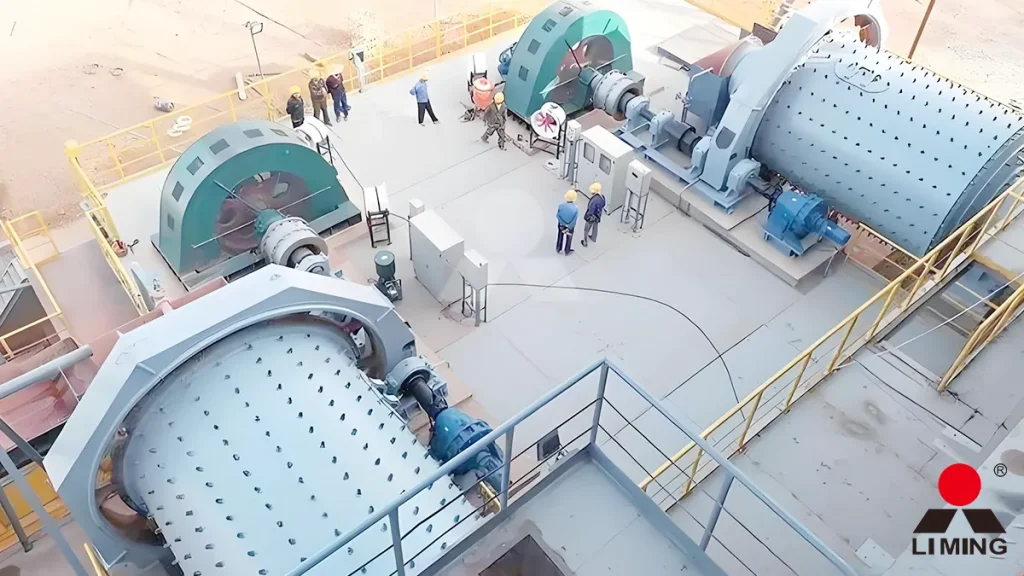
This is the most critical preparatory step. The ore must be ground fine enough to physically liberate the gold particles from the quartz matrix. The crushed ore is fed into a Ball Mill operating in a closed circuit with Hydrocyclones or spiral classifiers. The cyclone overflow (fine particles, often 60-80% passing -200 mesh) moves to the flotation circuit, while the coarse underflow returns to the ball mill for regrinding.
Stage 3: Slurry Conditioning
The finely ground slurry enters conditioning tanks where the pH is meticulously adjusted (often using lime to maintain an alkaline environment). Flotation reagents are introduced and aggressively mixed with the slurry to ensure optimal adsorption onto the mineral surfaces.
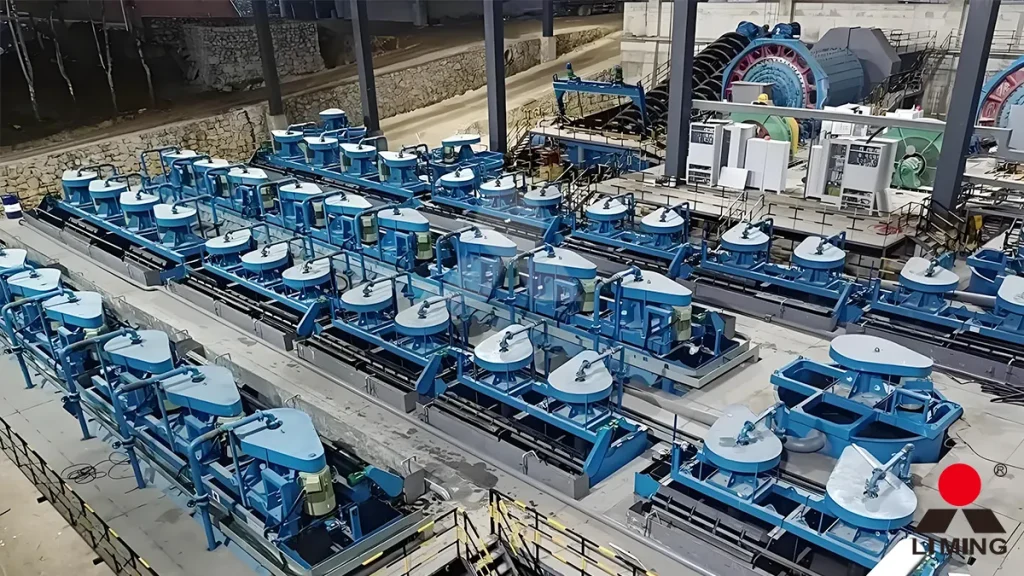
Stage 4: The Flotation Circuit (Roughing, Cleaning, and Scavenging)
The conditioned slurry flows into a bank of flotation cells. The process is divided into three functional zones:
- Roughing: The initial stage designed to recover the bulk of the gold-bearing minerals as quickly as possible.
- Cleaning: The rougher concentrate is subjected to multiple stages of re-flotation (cleaning) to reject entrained gangue and elevate the final concentrate grade.
- Scavenging: The tailings from the rougher cells are treated aggressively with extra reagents to "scavenge" any remaining slow-floating gold particles before the final tailings are discharged.
Stage 5: Concentrate and Tailings Dewatering
The final gold concentrate froth contains a massive amount of water. It is pumped to a high-rate thickener where flocculants are added to settle the solids. The thickened underflow is then processed through a filter press or ceramic filter to produce a dry concentrate cake ready for smelting or cyanidation. The tailings undergo a similar dewatering process before being pumped to a dry-stack tailings facility.
3. Combined Metallurgical Flowsheets for Complex Gold Ores
In reality, very few gold ores can be processed to completion using flotation alone. Refractory ores—those containing high levels of arsenic, antimony, carbon, or ultra-fine "invisible" gold locked in pyrite—require a combination of processes. Metallurgical engineers design hybrid flowsheets to maximize overall economic recovery.
A. Flotation + Concentrate Cyanidation
This is standard for quartz-vein ores containing gold-bearing sulfides. Rather than grinding the entire ore body to the ultra-fine sizes required for direct cyanidation (which requires massive power consumption), flotation is used to collect the gold into a small volume of sulfide concentrate. Only this concentrate is finely reground and subjected to cyanide leaching. This dramatically reduces grinding costs, lowers cyanide consumption, and reduces the required footprint of the leaching tanks.
B. Flotation + Concentrate Roasting + Cyanidation
This is the required flowsheet for highly refractory, double-refractory, or arsenical gold ores. Flotation collects the gold along with the problematic arsenopyrite or pyrite. This concentrate is then sent to a roaster. The high-temperature roasting oxidizes the sulfides into porous calcine and drives off the arsenic and sulfur gases. The porous calcine, with the gold now fully exposed, is then sent to the cyanidation circuit. Without roasting, the cyanide would not be able to penetrate the sulfide lattice to dissolve the gold.
C. Gravity Pre-Concentration + Flotation
For ores containing a mix of both coarse, free-milling gold and fine sulfide-bound gold, a hybrid physical-chemical approach is best. A centrifugal concentrator (like a Knelson or Falcon concentrator) is installed within the grinding circuit to capture the heavy, coarse free gold immediately. The tailings from the gravity circuit then flow to the flotation plant to recover the fine, sulfide-bound gold. Capturing the coarse gold early prevents it from becoming flattened or lost in the flotation cells.
D. Flotation + Concentrate Thiourea Leaching
For high-arsenic, high-sulfur, or carbonaceous ores where cyanidation is ineffective or environmentally restricted, thiourea leaching offers a non-toxic alternative. After flotation isolates the gold concentrate, an acidic thiourea solution is used to rapidly dissolve the gold. It boasts faster leaching kinetics than cyanide and is highly effective on carbonaceous (preg-robbing) ores.
E. Cyanidation + Tailings Flotation
In some plants, standard direct cyanidation fails to extract gold tightly bound within certain sulfide matrices. Instead of wasting this gold, the tailings from the cyanidation circuit are routed through a flotation plant. The flotation cells recover the remaining gold-bearing sulfides, which are then roasted or intensively leached to squeeze the final percentages of recovery out of the ore.
4. Case Study: 1500 TPD Polymetallic Rock Gold Plant
To put this into perspective, let’s analyze the flowsheet of a modern 1,500 Tons Per Day (TPD) rock gold plant processing a complex gold-copper ore.
- Crushing: A three-stage closed circuit (Primary Jaw Crusher → Secondary Cone Crusher → Tertiary Cone Crusher) reduces the ore to a uniform -12mm feed.
- Gravity Recovery: Within the grinding circuit, a centrifugal concentrator recovers 30% of the total gold as coarse, free-milling particles. This immediately reduces the burden on the downstream chemical circuits.
- Flotation (Rougher & Cleaner): The cyclone overflow is conditioned with Xanthate collectors. The flotation circuit produces a bulk gold-copper concentrate grading at 50 g/t of gold. The flotation recovery rate hits 85%.
- Leaching (CIL): The flotation concentrate is heavily reground and sent to a Carbon-In-Leach (CIL) circuit. The cyanide dissolves the gold, which is simultaneously adsorbed onto activated carbon. The CIL leaching efficiency reaches 92%.
- Refining: The carbon is stripped, and the gold is recovered via electrowinning, eventually being smelted into 99.99% pure gold bullion. The total combined recovery for the plant sits at a highly profitable 96.5%.
Expert Conclusion
The gold ore flotation process is the backbone of modern precious metal metallurgy. It is a highly dynamic process that requires strict control over particle size, fluid hydrodynamics, and reagent chemistry. Because no two gold deposits are identical, it is impossible to apply a "one-size-fits-all" flowsheet.
To achieve high recovery rates and strong economic returns, mine operators must conduct rigorous bench-scale and pilot-scale metallurgical testing. Understanding the mineralogy, the liberation size, and the preg-robbing characteristics of the ore allows engineers to design customized hybrid flowsheets—combining gravity, flotation, and leaching—that extract every possible ounce of gold from the rock.