
Introduction: Understanding Gold Ore Processing Plant
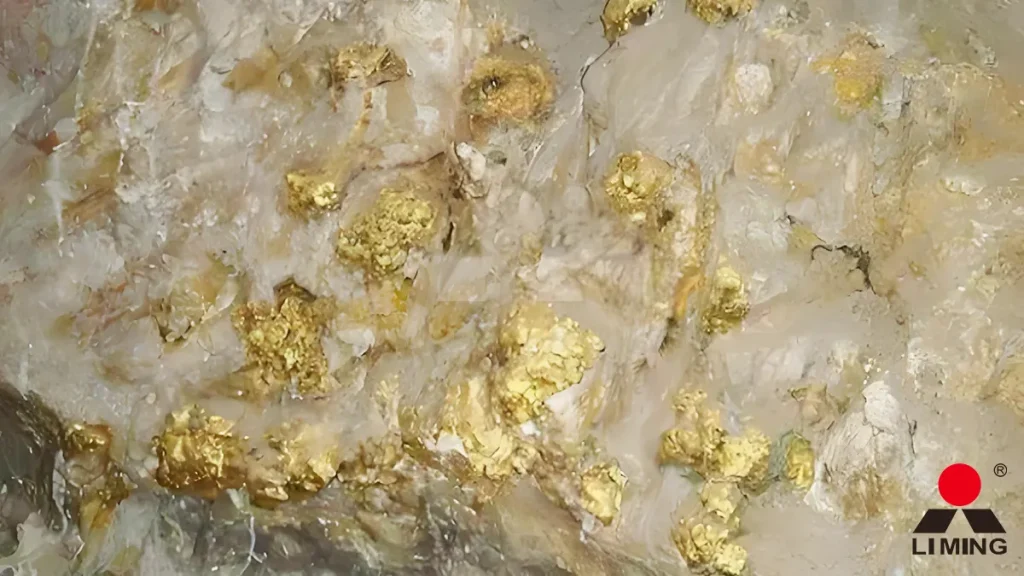
A gold ore processing plant is a complete industrial system designed to extract valuable gold minerals from mined ore through crushing, grinding, separation, and recovery processes. In the field of metallurgy and mining engineering, raw gold ore extracted from the earth—commonly referred to as run-of-mine (ROM) ore—cannot be sold directly to the market. The gold particles are typically microscopic and deeply embedded within host rocks such as quartz, pyrite, or arsenopyrite. To recover gold economically, mined ore must be processed through crushing, grinding, separation and recovery circuits designed according to its mineral characteristics.
The fundamental purpose of a gold ore beneficiation plant is to achieve "mineral liberation." This means mechanically breaking down the solid rock until the gold particles are exposed, allowing them to be separated from the worthless gangue minerals. However, there is no universal blueprint for this process. Gold ore characteristics vary drastically from one deposit to another. Gold grades may vary from low-grade deposits below 1 g/t to high-grade deposits containing several grams or more per ton, depending on the geological conditions, the hardness of the host rock, and the mineral composition all dictate the processing difficulty.
Gold Ore Types Determine Processing Methods
Before selecting equipment, engineers normally classify the gold ore according to its mineral characteristics. Oxide ores, free-milling ores, refractory sulfide ores and placer gold deposits require different processing methods because gold liberation characteristics are not the same.
For example, Many free-milling oxide ores can be processed using conventional cyanidation or gravity separation methods. Conversely, complex refractory sulfide ores require intensive grinding followed by froth flotation and oxidation before the gold can be extracted. Therefore, understanding the geological and mineralogical foundation of your specific ore body is the prerequisite for designing any effective gold extraction process.
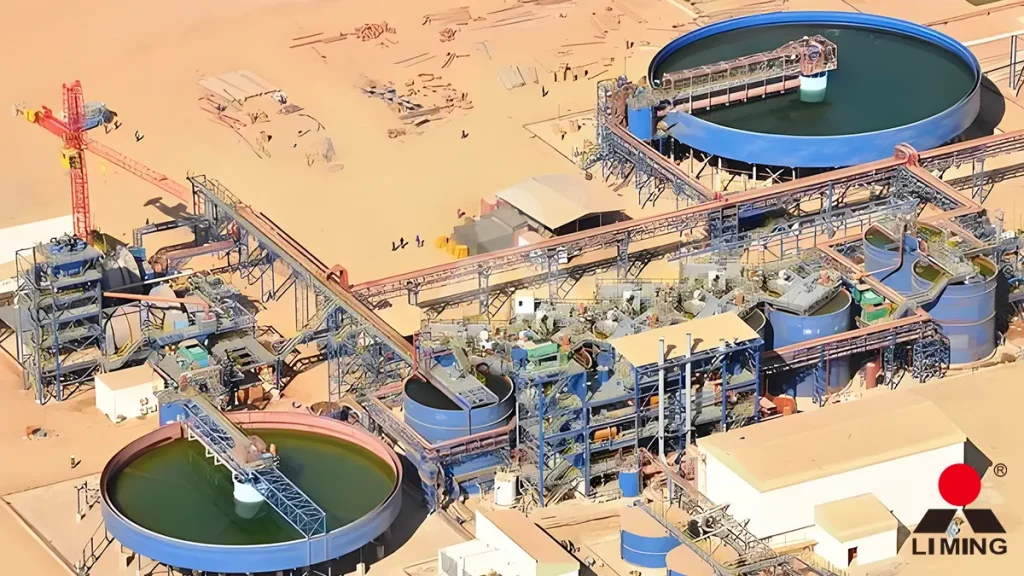
Main Factors Affecting Gold Ore Processing Plant Design
Every gold mining project requires a tailor-made gold ore processing plant design. Using a standard flowsheet without sufficient ore testing may result in lower recovery performance and unnecessary operating costs. Plant engineers must evaluate three primary factors before drafting the flowsheet.
Ore Properties
The physical and chemical properties of the ore dictate the entire mechanical configuration of the gold processing plant. Engineers must analyze:
- Gold particle size: Are the particles coarse enough for gravity separation, or are they microscopic, requiring intensive ultrafine grinding?
- Gold distribution: Is the gold disseminated evenly throughout the rock, or is it concentrated in specific quartz veins?
- Associated minerals: The presence of "preg-robbing" carbon or high levels of copper and arsenic can severely disrupt the cyanidation process, requiring specialized pre-treatment circuits.
- Hardness: Evaluated using the Bond Work Index (BWI), the hardness of the rock determines the size, power, and wear-part materials needed for the crushers and grinding mills.
Production Capacity
The scale of the operation directly impacts the equipment selection and infrastructure requirements. Plant capacities are generally categorized into three tiers:
- Small scale (10–50 TPH): Typically designed for junior mining companies or high-grade vein deposits. These plants prioritize lower initial investment, modular equipment, and rapid deployment.
- Medium scale (50–200 TPH): The industry standard for commercial open-pit or large underground operations. These require robust two- or three-stage crushing circuits and highly automated processing lines.
- Large scale (200+ TPH): Built for massive, low-grade deposits. These facilities often utilize enormous Semi-Autogenous Grinding (SAG) mills and extensive Carbon-in-Leach (CIL) tank farms to achieve economies of scale.
Final Recovery Requirement
The ultimate goal of any gold extraction process is to maximize the final recovery rate. The recovery rate depends entirely on the mineralogy, the precision of the process selection, and the reliability of the equipment configuration. A poorly configured grinding circuit that fails to liberate the gold will result in the precious metal being discarded into the tailings pond, reducing overall project economics and recovery performance.
Metallurgical Test Results
Metallurgical testing is an important step before plant design. Engineers usually conduct laboratory tests to evaluate grinding performance, gold recovery methods, reagent requirements and ore variability.
Complete Gold Ore Processing Plant Flow Chart
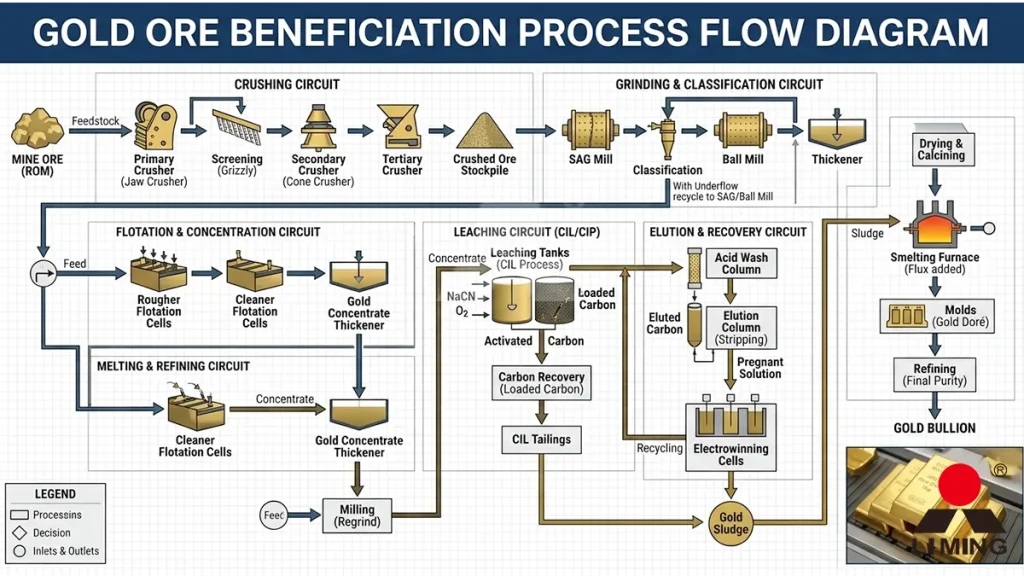
The transformation of raw rock into gold bullion follows a strict mechanical and chemical sequence. The complete gold ore processing plant flow chart is generally divided into three major phases: comminution (crushing and grinding), separation, and recovery.For hard rock gold deposits, the typical flow sheet includes crushing, grinding, classification and recovery circuits designed according to mineral liberation requirements.
Raw Gold Ore
↓
Primary Crushing
↓
Secondary Crushing
↓
Grinding
↓
Classification
↓
Gravity Separation / Flotation / CIL
↓
Gold Recovery
↓
Tailings Treatment
Crushing Process
The crushing stage is designed to reduce large run-of-mine ore into a suitable feed size for the grinding circuit. Because crushing rock mechanically is significantly more energy-efficient than grinding it in a mill, the industry adheres to the principle of "more crushing, less grinding."
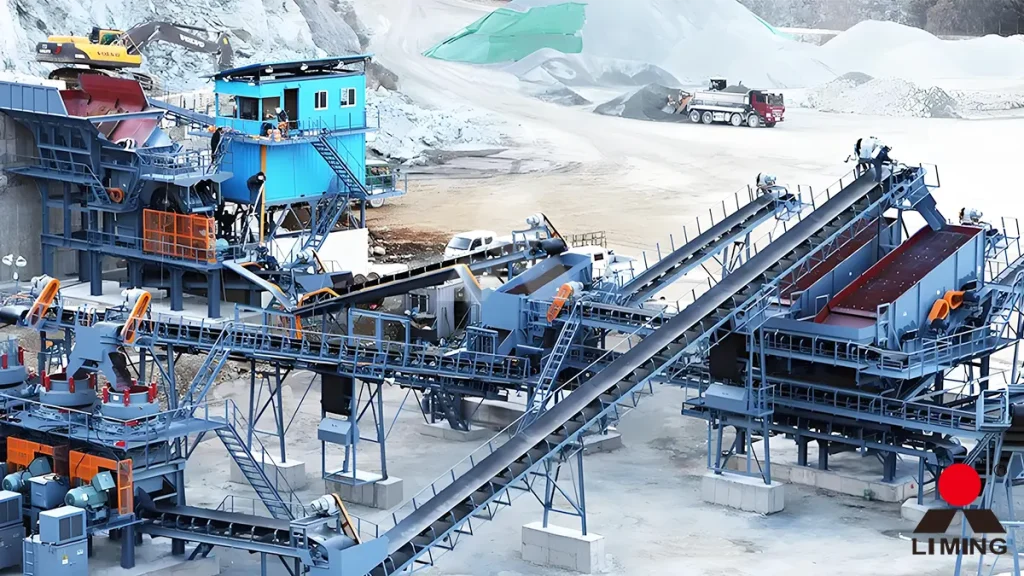
Primary reduction is typically handled by a Jaw Crushers are commonly used to reduce large run-of-mine rocks into a manageable size for downstream processing. For the secondary and tertiary stages, engineers usually select cone crushers for hard and abrasive gold ores, while impact crushers may be considered for softer ores with lower abrasiveness. The objective is to produce a uniform crushed product—usually smaller than 12mm to 15mm—which maximizes the throughput and efficiency of the downstream ball mills.
Grinding Process
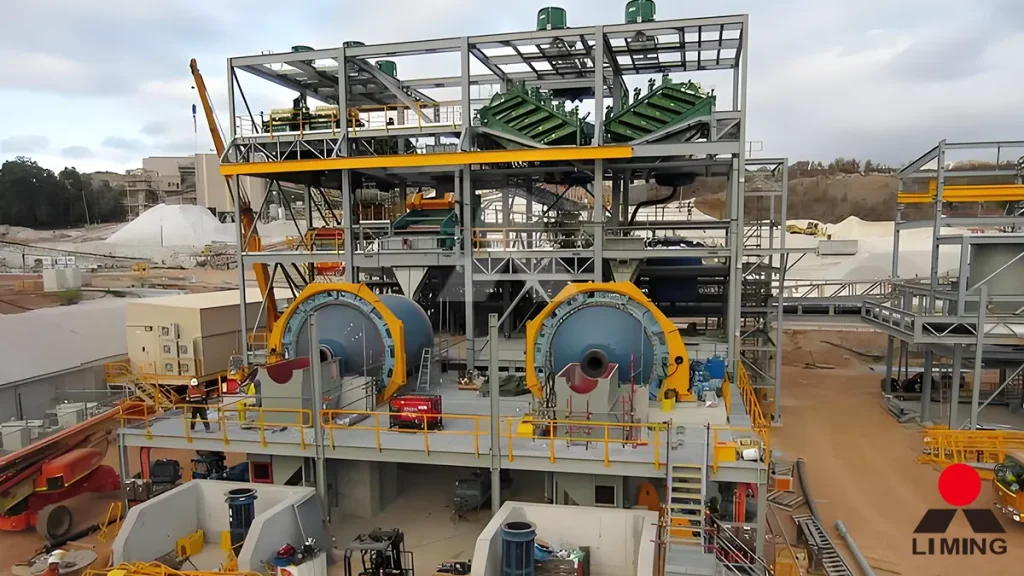
Grinding is the most energy-intensive phase of the gold ore crushing and grinding process. The crushed ore is usually fed into a Ball Mill or SAG Mill depending on the plant capacity and ore hardness. Inside the rotating cylinder, heavy steel balls cascade and shatter the ore into a fine powder, typically suspended in a water slurry.
Grinding determines the liberation degree of the minerals. The ore must be ground fine enough to physically expose the microscopic gold particles. If the ore is under-ground, the gold remains locked inside the waste rock; if it is over-ground, it creates "slimes" that interfere with chemical recovery. Therefore, the grinding mill always works in a closed circuit with classification equipment (like hydrocyclones) to maintain the required particle size distribution.
Separation and Gold Recovery
Once liberated, the gold is separated using methods dictated by the ore's specific characteristics.
- Gravity Separation: Suitable for coarse free gold. Because gold is significantly denser than common rock, equipment like a Jig, Shaking table, or Spiral concentrator uses water and gravity to separate the heavy gold particles from the lighter gangue.
- Flotation Process: The optimal choice for complex sulfide gold ore. In Flotation cells, chemical reagents are added to the slurry, causing the gold-bearing sulfide minerals to become hydrophobic. Air bubbles are introduced, and the gold attaches to the bubbles, rising to the surface as a froth that is skimmed off as a high-grade concentrate.
- Cyanide Leaching / CIL-CIP (Carbon-in-Leach / Carbon-in-Pulp): A commonly used recovery method for large-scale gold plants processing free-milling and oxide ores. The fine slurry is pumped into massive agitated tanks where a weak cyanide solution dissolves the gold. Activated carbon is then introduced into the tanks (Carbon adsorption) to pull the dissolved gold out of the solution, leading to final gold recovery through electrowinning and smelting.
- Heap Leaching Process: Heap leaching is commonly used for low-grade oxide gold deposits where crushing and stacking ore before irrigation with leaching solution can provide an economical recovery method.Heap leaching is generally selected after evaluating ore permeability, gold liberation characteristics and economic conditions.
Key Equipment Used in Gold Ore Processing Plant
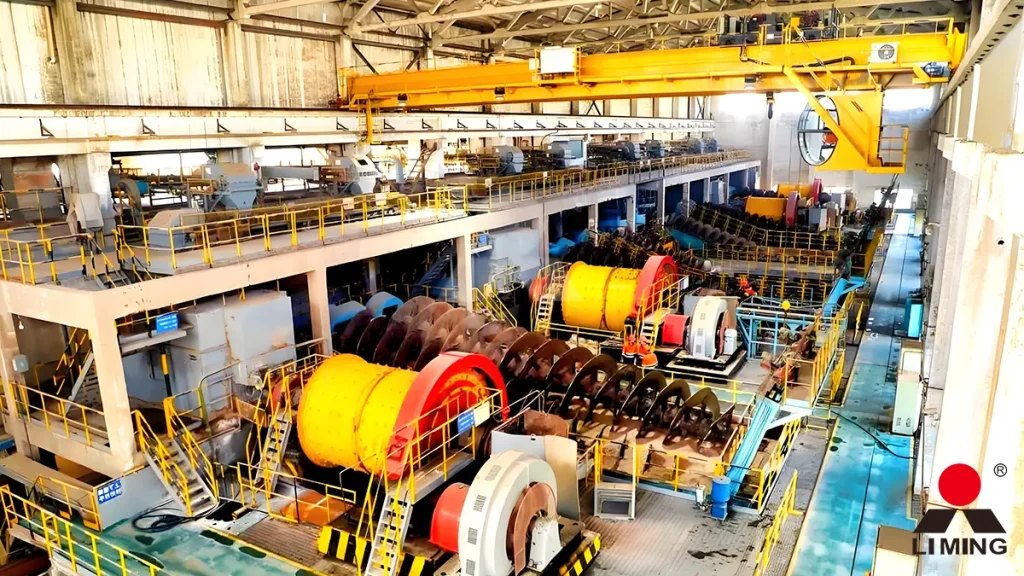
The reliability of gold mining equipment has a significant influence on plant availability, operating efficiency and maintenance costs. A failure in the primary crushing station will halt the entire production line. Below is a detailed engineering breakdown of the core processing equipment required for a standard commercial facility.
| Equipment | Function | Typical Application |
|---|---|---|
| Jaw Crusher | Primary crushing | Hard rock gold ore |
| Cone Crusher | Secondary crushing | High hardness ore |
| Ball Mill | Fine grinding | Mineral liberation |
| Hydrocyclone | Classification | Closed grinding circuit |
Understanding the application of each machine is critical for plant optimization:
Jaw Crusher
In hard rock gold mining operations, jaw crushers are usually installed as the first crushing stage because they can handle large feed materials with stable performance. Featuring a deep V-shaped crushing cavity, modern jaw crushers (such as Liming Heavy Industry's C6X series) are designed to handle large run-of-mine feed materials in hard rock crushing applications. The compressive crushing action is ideal for high-silica, highly abrasive gold ores, ensuring long wear life for the manganese jaw plates.
Cone Crusher
Operating as the secondary or tertiary stage, hydraulic cone crushers utilize a principle known as lamination crushing. As the mantle moves eccentrically, the rock is squeezed against the bowl liner and against other rocks. This rock-on-rock action produces a finely crushed, uniform output (usually 5mm to 40mm) which drastically improves the downstream grinding efficiency of the ball mill.
Ball Mill
The ball mill is usually the main grinding equipment in a gold processing plant, and its performance directly affects mineral liberation and downstream recovery. It rotates continuously, utilizing the kinetic energy of cascading steel balls to pulverize the crushed ore into a fine slurry. Depending on the mineralogy, the ball mill must grind the material until the required product size is determined by mineralogical characteristics and recovery requirements, with many operations targeting fine grinding below 74 microns, achieving total mineral liberation.
Flotation Machine
Used primarily for sulfide ores, flotation machines consist of a series of aerated tanks equipped with mechanical agitators. The precision of the agitator design ensures that air bubbles are perfectly sized to capture the gold-bearing sulfide particles. Maintaining the correct slurry density and aeration rate in these cells is essential for maximizing the recovery grade.Maintaining the correct slurry density and aeration rate is essential for improving recovery performance and concentrate quality.
Gold Ore Processing Plant Design Considerations
Designing a gold processing plant involves more than equipment selection. Engineers must consider ore characteristics, site conditions, infrastructure availability and environmental requirements when developing the plant design.
Site Conditions
Engineers must first evaluate the macro-environment of the project. The Location and topography dictate how the material flows; utilizing gravity in a hillside layout can reduce pumping requirements and operating energy consumption. Climate plays a crucial role—plants in sub-zero regions require insulated piping, while tropical plants must manage monsoon drainage. Furthermore, Water availability and power supply stability influence the selection of processing methods, grinding systems and supporting infrastructure, and whether diesel generators are required as primary or backup power sources.
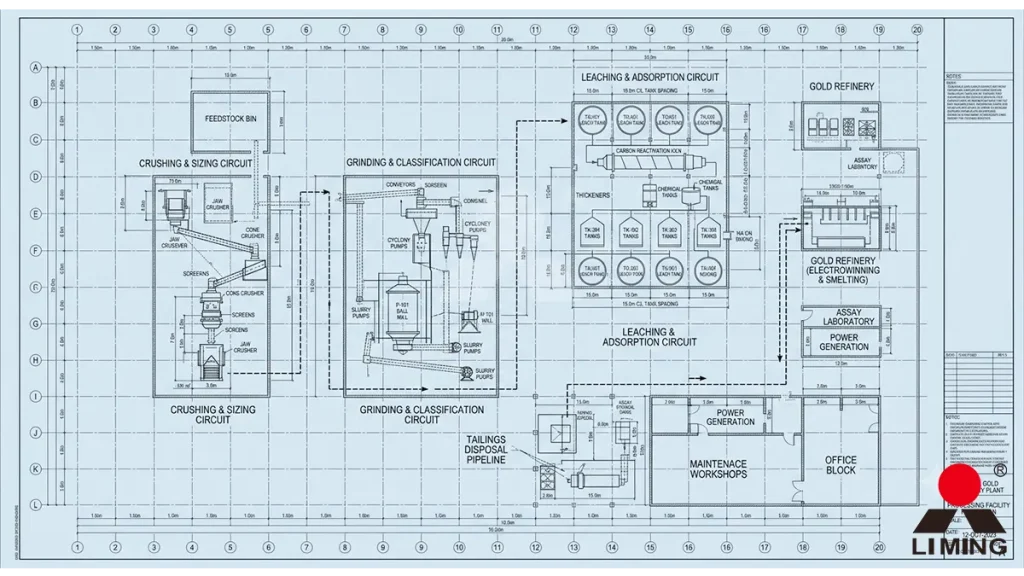
Plant Layout
The spatial arrangement of the gold processing equipment is a critical engineering task. A logical, streamlined layout is designed to reduce material transportation distances via conveyor belts and slurry pipelines. Minimizing these distances reduces wear and tear, lowers power consumption, and directly contributes to a lower overall operating cost. Maintenance access must also be engineered into the layout, ensuring that heavy cranes can easily reach crushers and mills during shutdown periods.
Environmental Requirements
Modern mining operations are strictly regulated. The plant design must include robust Dust control systems at every crushing transfer point. Tailings management is arguably the most sensitive aspect of the design; dry-stack tailings or engineered impoundment dams must be constructed to prevent ecological contamination. Additionally, advanced Water recycling circuits utilizing high-efficiency thickeners and filter presses are increasingly adopted in modern mining operations, often allowing a significant portion of process water to be recycled within the plant.
Small Gold Ore Processing Plant Solutions
Not all gold mining projects require large-scale processing facilities. For small deposits, exploration projects or operations with limited production targets, a compact gold processing plant provides a practical alternative to large-scale facilities, a small gold processing plant offers a practical alternative with lower initial investment requirements. These systems are typically scaled to handle capacities such as 10 TPH, 20 TPH, or 50 TPH.
The primary advantage of a small-scale solution is the significantly lower initial investment. Rather than pouring massive concrete foundations, these plants frequently utilize a modular design. Equipment is pre-assembled on steel skids or integrated into wheeled mobile platforms at the factory. This modular design can reduce civil construction requirements and shorten installation time at the mining site.
Furthermore, small plants prioritize easier operation and maintenance. A common setup for a 20 TPH high-grade quartz vein deposit might include a small mobile jaw crusher, a compact hammer mill or small ball mill, feeding directly into a series of shaking tables or a centrifugal concentrator. This lean configuration allows operators to start production sooner after installation and commissioning, compared with the longer construction schedules normally associated with large-scale plants.
How Much Does a Gold Ore Processing Plant Cost?
Determining the exact financial outlay for a mining facility requires a detailed feasibility study. However, understanding the Factors Affecting Gold Processing Plant Cost helps investors develop a preliminary budget estimate.
1. Capacity: The fundamental rule of plant engineering is that larger throughput usually requires larger equipment, more supporting infrastructure and higher investment. A 500 TPH plant requires massive structural steel, heavy-duty gearboxes, and extensive civil works compared to a 50 TPH facility.
2. Ore Type: The mineralogy dictates the process, which dictates the cost. An oxide ore that is easily processed through a gravity circuit is the cheapest to build. Conversely, a refractory sulfide ore requires ultra-fine grinding, froth flotation, and potentially expensive roasting or pressure oxidation circuits, driving the costs significantly higher.
3. Equipment Selection: Choosing between tier-one heavy-duty mining equipment and lighter aggregate-grade machinery will heavily influence the initial purchase price. However, investing in robust crushers and mills reduces downtime and replacement part costs, lowering the overall life-cycle expenditure.
4. Automation Level: Integrating advanced PLC (Programmable Logic Controller) and SCADA systems requires a higher upfront financial commitment for sensors, automated valves, and control room infrastructure. Yet, Automation can improve process stability, monitoring accuracy and operational efficiency. It may also reduce the amount of manual intervention required during operation.
Ultimately, the typical cost range depends on the processing capacity, the harshness of the mining conditions, the specific equipment configuration, and the local installation requirements.
Why Choose Liming Heavy Industry for Gold Ore Processing Plant?
When investing in a complete metallurgical facility, partnering with an experienced manufacturer can help reduce project risks related to equipment selection and integration. Liming Heavy Industry provides crushing, grinding and complete mineral processing equipment for mining projects worldwide. Based on different ore conditions and production requirements, our engineers develop customized equipment configurations and plant solutions.
Engineering Capability
Our engineering team develops processing layouts and equipment configurations based on ore conditions and production requirements.With extensive overseas project experience, our engineers understand how to design flowsheets that adapt equipment configurations to different site conditions, including climate, transportation conditions and available infrastructure.
Equipment Manufacturing
Quality control begins on our factory floor. We manufacture the complete spectrum of comminution machinery, including heavy-duty jaw crushers, high-efficiency hydraulic cone crushers, and precision grinding mills. Because we produce the core components of complete production lines in-house, we help ensure better compatibility between equipment and the overall production line.
Customer Support
A mining project does not end when the equipment is shipped. Liming Heavy Industry provides end-to-end customer support. This includes initial mineral testing and process design, precise equipment selection, on-site installation guidance, and comprehensive operational training for your local workforce, helping operators achieve stable production and the expected recovery performance after commissioning.

Example Configuration of Gold Ore Processing Plant
To demonstrate how theoretical plant design translates into real-world operations, below are three exact configurations engineered for different gold ore types. These cases highlight how capacity and mineralogy dictate the equipment selection.
Case 1: Medium-Scale Sulfide Gold Ore Flotation Plant
This configuration was designed for a high-grade underground deposit where gold is heavily encapsulated within pyrite and arsenopyrite, making flotation is commonly selected as the primary recovery method before concentrate treatment.
- Project Type: Hard rock sulfide gold ore
- Capacity: 100 TPH
- Typical Feed Grade: 6.5 g/t (example value)
- Process: Primary crushing → Secondary crushing → Grinding → Classification → Rougher/Scavenger/Cleaner Flotation
- Main Equipment:
• C6X110 Jaw Crusher (Primary)
• HST250 Single-Cylinder Cone Crusher (Secondary)
• Φ2700×3600 Overflow Ball Mill
• FX500 Hydrocyclone Group
• XCF/KYF Series Flotation Machines (16 cells) - Grind Size target: 80% passing -200 mesh (74 microns)
- Expected recovery: depends on ore characteristics and metallurgical test results.
Case 2: Large-Scale Oxide Gold Ore CIL Plant
Built for a massive open-pit operation, this plant processes heavily weathered, free-milling oxide ore. Because the ore is softer but lower in grade, achieving a high daily throughput using the Carbon-in-Leach (CIL) method is important for achieving economic operation.
- Project Type: Open-pit oxide gold ore
- Capacity: 300 TPH
- Feed Grade: 1.8 g/t
- Process: Two-stage closed-circuit crushing → Grinding → Trash screening → Thickening → Cyanide Leaching (CIL) → Desorption & Electrowinning
- Main Equipment:
• PEW860 Jaw Crusher
• 2x HPT300 Multi-Cylinder Cone Crushers
• Φ3200×4500 Ball Mill
• 24-meter High-Rate Thickener
• 8x Double-Impeller Agitation Leaching Tanks - Grind Size target: 70% passing -200 mesh
- Final Recovery: Expected recovery is determined by ore characteristics and metallurgical testing.
Case 3: Small-Scale Placer Gold Gravity Plant
Deployed in a remote river basin, this modular plant processes alluvial sand and gravel. The design minimizes chemical usage by relying mainly on gravity separation methods to comply with strict local environmental regulations, relying mainly on specific gravity differences to recover coarse gold particles.
- Project Type: Alluvial / Placer gold ore
- Capacity: 50 TPH
- Feed Grade: 0.8 g/t
- Process: Raw material washing → Trommel screening → Primary gravity concentration → Secondary shaking table separation
- Main Equipment:
• Heavy-duty Rotary Scrubber
• GT1545 Trommel Screen
• 2x STLB60 Centrifugal Concentrators
• 6-S Shaking Tables - Water Usage: 80% recycled via tailings settling ponds
- Final Recovery: Recovery performance depends on gold particle size distribution and testing results.
Frequently Asked Questions (FAQ)
Based on our engineering experience and the most common inquiries from mine operators, here are the technical answers to the most frequently asked questions regarding gold processing.
Q1: What factors affect gold processing plant design?
The design is dictated primarily by the ore's mineralogy (oxide, sulfide, or placer) and its Bond Work Index (hardness). Other critical factors include the target daily throughput, the presence of interfering elements (like copper, arsenic, or preg-robbing carbon), and site-specific constraints such as water availability and power grid stability.
Q2: What equipment is needed for a 100 TPH gold processing plant?
Equipment may include jaw crushers, cone crushers, ball mills, hydrocyclones and flotation or leaching equipment depending on ore type. For example, Liming Heavy Industry provides C6X and HST series equipment, a heavy-duty Overflow Ball Mill (approx. 2.7m x 3.6m), a hydrocyclone group for classification, and either a 10-14 cell flotation circuit or a series of large agitation leaching tanks, depending on whether you are recovering sulfide or oxide gold.
Q3: What is the difference between gravity separation and flotation?
Gravity separation is a physical process that exploits the high density of gold to separate coarse, free-milling particles using water and motion (via jigs or shaking tables). Flotation is a physicochemical process used for fine gold locked inside sulfide minerals; it uses chemical reagents to make the gold-bearing minerals hydrophobic so they attach to air bubbles and float to the surface as a concentrate.
Q4: How much does a small gold processing plant cost?
Costs vary significantly depending on equipment configuration, location, infrastructure requirements and processing method. However, a 50 TPH hard-rock CIL (Carbon-in-Leach) plant requires crushers, ball mills, cyanide tanks, and detoxification systems, pushing the equipment and infrastructure costs well into the millions. You are paying for the chemical extraction complexity.
Q5: How does Liming design a gold processing solution?
The process starts with ore testing and mineralogical analysis. We start by analyzing your raw ore samples in a metallurgical lab. Based on the liberation size and recovery rate data, our engineers draft a customized flow sheet. We then size the crushers and mills to match your target TPH, manufacture the equipment, and provide on-site EPC (Engineering, Procurement, Construction) installation and commissioning.
Q6: Why use a cone crusher instead of an impact crusher for gold ore?
Gold is usually hosted in quartz or basalt veins, which have an extremely high silica content and abrasion index. If you put high-silica rock into an impact crusher, it may result in significantly higher wear rates of impact crusher wear parts. Cone crushers use compressive (lamination) crushing, which can reduce wear part consumption in hard rock applications and lowers your operating expenses on hard rock.
Q7: Can I process hard rock gold ore without using cyanide?
Yes, but only if the gold is coarse and "free-milling." In such cases, you can use a grinding circuit followed by centrifugal concentrators and shaking tables (gravity separation). However, if the gold is microscopic and disseminated throughout oxide rock, cyanidation (CIL/CIP) is one of the most widely used commercial methods for recovering fine gold from many ore types.
Q8: What causes a low gold recovery rate in a ball mill circuit?
The most common culprit is poor classification leading to either under-grinding or over-grinding. Under-grinding means the gold remains locked inside the host rock. Over-grinding turns the rock into ultra-fine "slimes," which coat the gold particles and prevent chemical reagents or air bubbles from attaching to them. Usually, adjusting the hydrocyclone pressure or ball charge fixes this.
Q9: What is the minimum capacity for a profitable hard rock gold plant?
Profitability depends entirely on your ore grade. If you are mining a high-grade underground vein (e.g., 10-15 g/t), a small 20 TPH plant can potentially support economic operation. However, for low-grade open-pit operations (e.g., 1.5 g/t), you typically need to process at least 100 to 200 TPH to offset the daily energy and chemical costs.
Q10: What is the difference between CIL and CIP gold processing?
Both use cyanide and activated carbon. In CIL (Carbon in Leach), the leaching (dissolving gold) and adsorption (carbon soaking up gold) happen simultaneously in the same tanks; this is great for ores with "preg-robbing" natural carbon. In CIP (Carbon in Pulp), the ore is fully leached in the first few tanks, and carbon is only added in the final tanks.
Operating a successful gold extraction facility is a complex engineering challenge. As outlined in this guide, the optimal beneficiation process depends entirely on the unique properties of your ore body. Utilizing the correct primary and secondary crushing stages, followed by precise grinding, improves mineral liberation performance. Furthermore, proper equipment selection determines the overall mechanical efficiency, while professional plant layout design improves the final gold recovery rate and lowers long-term operating costs.
Whether you are developing a small-scale gravity circuit or a massive, fully automated Carbon-in-Leach facility, Liming Heavy Industry provides customized crushing, grinding and mineral processing solutions based on different ore conditions and production requirements.