
Feldspar is the most abundant group of rock-forming minerals on Earth's surface, primarily composed of aluminosilicates containing potassium, sodium, and calcium. Whether it is potassium feldspar, sodium feldspar, or lithium feldspar, this versatile mineral is a cornerstone raw material for the ceramics, glass, chemical, and abrasive industries.
However, the modern glass and high-end ceramics markets demand premium, high-purity feldspar with exceedingly low iron content. Run-of-mine (ROM) feldspar ore rarely meets these strict market specifications. It is usually intertwined with impurities like quartz, mica, iron oxides, and rutile. To unlock its commercial value, the ore must pass through a highly engineered crushing and beneficiation plant.
Step 1: The Feldspar Crushing and Screening Circuit
Feldspar ore is generally extracted via open-pit mining. The primary objective of the comminution stage is to reduce the large rock blocks down to a specific size suitable for the grinding mills. Depending on the feed size, plants utilize either a two-stage or three-stage closed-circuit crushing layout.
Primary Crushing
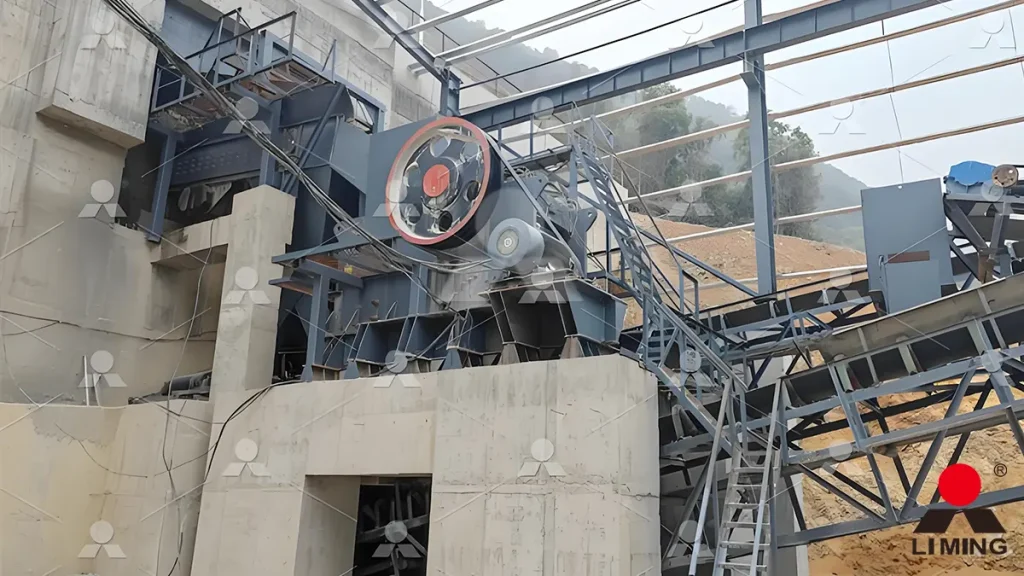
The raw ore is loaded into a hopper and fed steadily into the primary crusher. For this stage, heavy-duty equipment like the Liming C6X110 Jaw Crusher is deployed. Powered by a 160 kW motor, it handles massive feed sizes up to 720 mm. Its deep "V-shaped" crushing cavity aggressively breaks down the tough feldspar lumps, offering a processing capacity ranging from 160 to 550 t/h.
Secondary Crushing and Screening
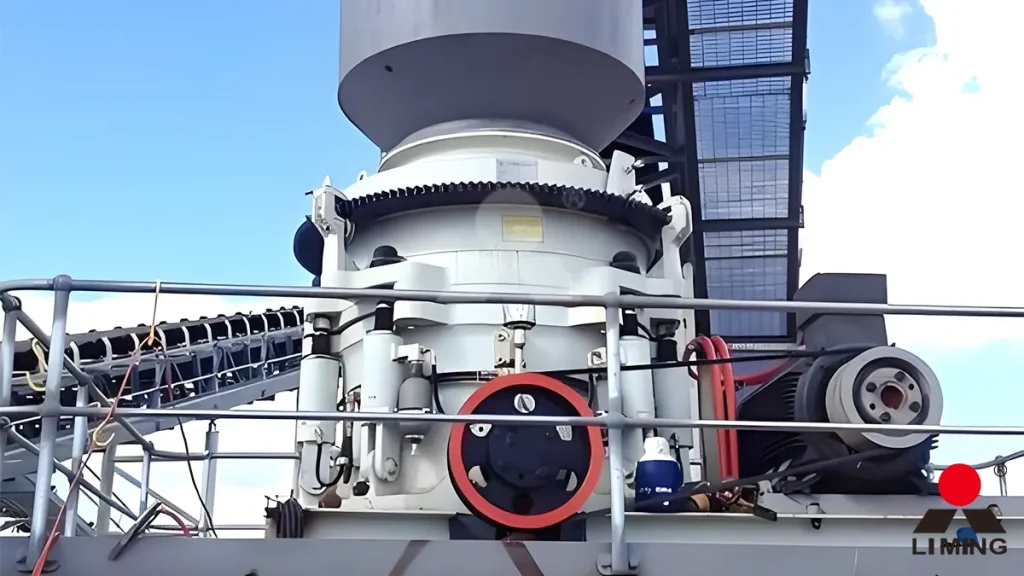
Because feldspar requires controlled, uniform particle sizes before grinding to prevent over-milling, the secondary crushing stage is critical. The HPT300 Multi-Cylinder Hydraulic Cone Crusher (250 kW) is highly recommended. It utilizes lamination crushing to reduce the primary discharge down to below 20mm, providing a capacity of 110-440 t/h.
To ensure strict size control, the crushed material passes over an S5X2160-3 Vibrating Screen. Driven by a 30 kW motor, this 3-layer screen separates the material. The oversize material loops back to the HPT300, while the correctly sized particles move forward to the fine ore bins.
Step 2: Grinding and Classification
Physical liberation is the prerequisite for removing impurities. The crushed feldspar is fed into a wet Grate Ball Mill or Overflow Ball Mill. Wet grinding is significantly more efficient than dry grinding for feldspar and helps mitigate hazardous dust issues.
The ball mill operates in a closed circuit with classification equipment, typically spiral classifiers or hydrocyclones. The underflow (coarse material) is returned to the mill for regrinding, while the fine overflow achieves the exact liberation size required for downstream chemical separation.
Step 3: Washing and Desliming
Feldspar ores, particularly those sourced from weathered granite or placer deposits, often contain high amounts of clay, mud, and primary slimes. If these fine slimes enter the flotation or magnetic separation circuits, they will consume expensive reagents and ruin the separation efficiency.
The slurry is processed through a desliming cone or log washer. This mechanical scrubbing effectively removes the clay and secondary slimes generated during grinding, preparing a clean mineral surface for the next stages.
Step 4: High-Gradient Magnetic Separation (Iron Removal)
Iron is strictly prohibited in high-end glass manufacturing because it causes dark discoloration. In feldspar, iron typically exists in weakly magnetic minerals like mica, garnet, and tourmaline.
Because these impurities possess only weak magnetic properties, standard magnetic separators are insufficient. The plant must utilize High-Gradient Magnetic Separators (HGMS) operating at 8,000 to 10,000 Gauss. These machines effectively pull the iron-bearing minerals out of the feldspar stream, dropping the Fe₂O₃ content to well below market limits.
Step 5: Froth Flotation
Flotation is the ultimate tool for achieving high-grade feldspar. It serves two main purposes: removing residual titanium/iron impurities and separating the feldspar from quartz.
Removing Titanium and Iron Gangue
Titanium usually exists as rutile or sphene. Using fatty acid collectors, rutile can be floated in a weakly acidic environment (pH 4-6). For residual mica, amine cationic collectors are highly effective at a pH of 2.5–3.5.
Feldspar and Quartz Separation
Because feldspar and quartz have nearly identical specific gravities and magnetic properties, flotation is the only reliable way to separate them. Historically, the hydrofluoric (HF) acid method was the commercial standard. However, due to severe environmental and safety concerns, modern processing plants overwhelmingly prefer fluorine-free flotation processes.
Even more challenging is separating potassium feldspar from sodium feldspar, as they share similar crystal structures. Advanced reagent regimes and multi-stage cleaning circuits are engineered specifically to isolate these valuable compounds.
Step 6: Dewatering, Drying, and Packaging
The final purified feldspar concentrate is in a wet slurry form. It is first pumped into a thickener, followed by a filter press or vacuum filter to mechanically remove the bulk of the water.
The damp filter cake is then fed into a rotary drum dryer or flash dryer, which uses thermal energy to reduce the final moisture content to below 0.5%. Once cooled and quality-tested, the premium feldspar powder is packaged using automated bagging machines into 25kg bags or 1-ton bulk bags, ready for shipping.