
Abstract: Silica (quartz) is a foundational industrial mineral, but raw run-of-mine ore requires intense processing to achieve high-purity standards. Because of its extreme hardness and abrasiveness, silica processing requires heavy-duty comminution—primarily Jaw and Cone crushers followed by VSI Sand Makers. This comprehensive engineering guide explores the complete silica processing flowsheet, including wet rod milling, attrition scrubbing, magnetic separation, and froth flotation, detailing the exact technologies needed to remove iron and feldspar impurities and produce high-grade silica sand.
Silica (silicon dioxide, SiO₂) is one of the most ubiquitous and industrially vital non-metallic minerals on Earth. Existing primarily as quartz sandstone, quartzite, and vein quartz, silica forms the backbone of modern manufacturing. Depending on its purity, processed silica is essential for producing everything from standard construction aggregates and foundry sand to high-tech semiconductor wafers, fiber optics, and photovoltaic glass.
However, raw silica ore mined directly from the earth is rarely pure enough for immediate industrial use. It is typically contaminated with iron oxides (hematite, limonite), mica, feldspar, and clay. To transform raw quartz rock into high-purity silica sand, it must undergo a rigorous, multi-stage processing technology that includes mechanical crushing, grinding, washing, and complex chemical beneficiation.
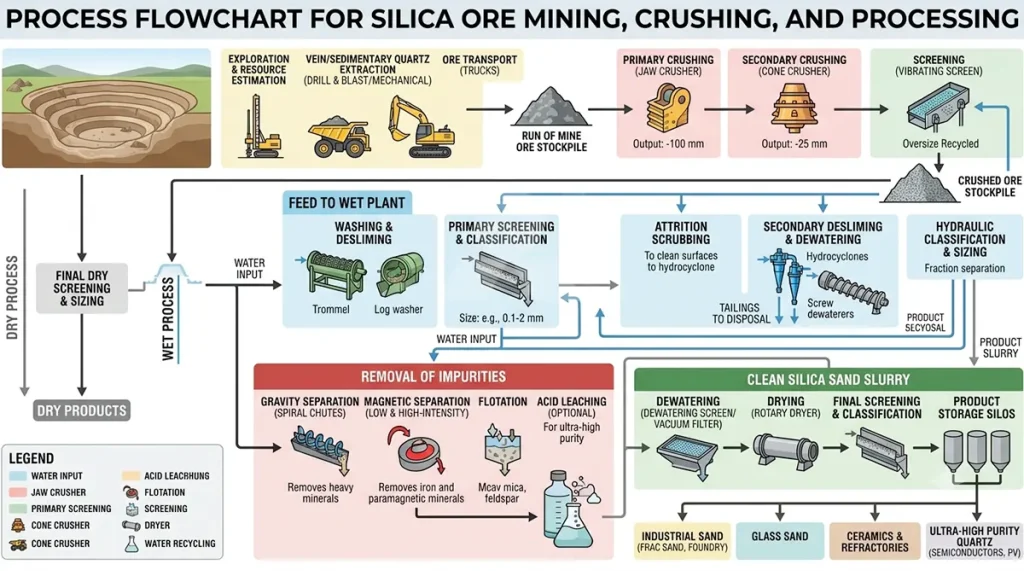
This engineering guide breaks down the complete silica ore processing flow, detailing the specific technologies and heavy-duty equipment required at each stage.
1. The Silica Crushing and Sand-Making Circuit
Silica ore is notoriously hard (Mohs hardness of 7) and highly abrasive. Processing it requires comminution equipment built to withstand extreme wear. The primary goal of this stage is to reduce massive quartz boulders down to a specific grain size (typically between 0.020mm and 3.350mm) while generating a perfectly cubic particle shape.
Primary Crushing: Jaw Crushers
The run-of-mine (ROM) silica boulders are fed by a heavy-duty vibrating feeder (equipped with a grizzly screen to bypass fines) into a primary Jaw Crusher. For highly abrasive quartz, premium machines like the Liming C6X Series Jaw Crusher are ideal. Utilizing a deep "V-shaped" crushing cavity and high-manganese steel jaw plates, it efficiently fractures the hard silica via compression, reducing boulders up to 1200mm down to a manageable 100-300mm size.
Secondary Crushing: Cone Crushers
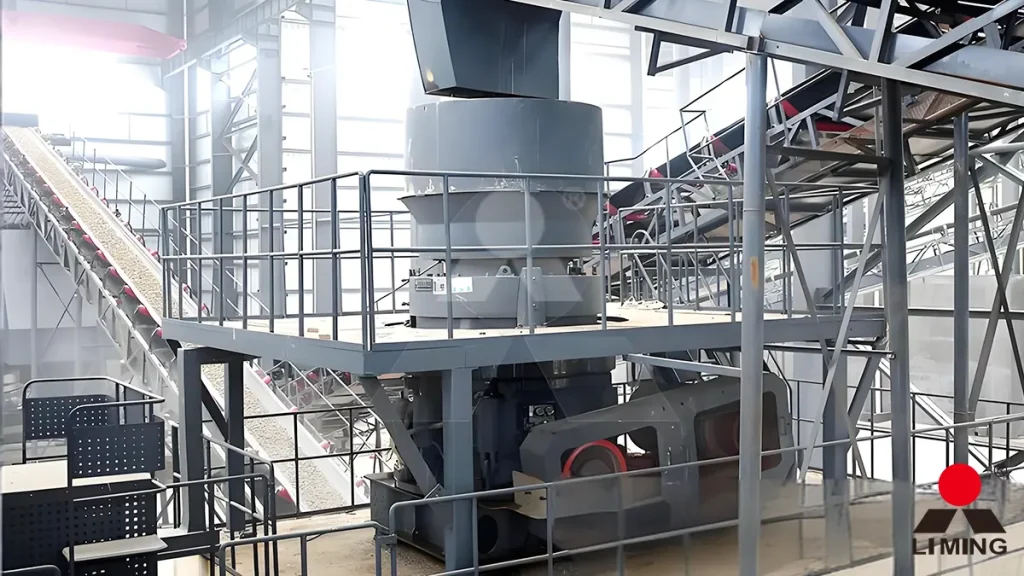
Because silica is so hard, impact crushers are generally avoided in the secondary stage as the blow bars would wear out too quickly. Instead, the primary discharge is sent to a Cone Crusher. Machines like the Liming HPT Multi-Cylinder Hydraulic Cone Crusher use a lamination crushing principle (rock-on-rock compression), which minimizes wear part consumption and provides excellent throughput.
Tertiary Crushing & Shaping: VSI Sand Makers
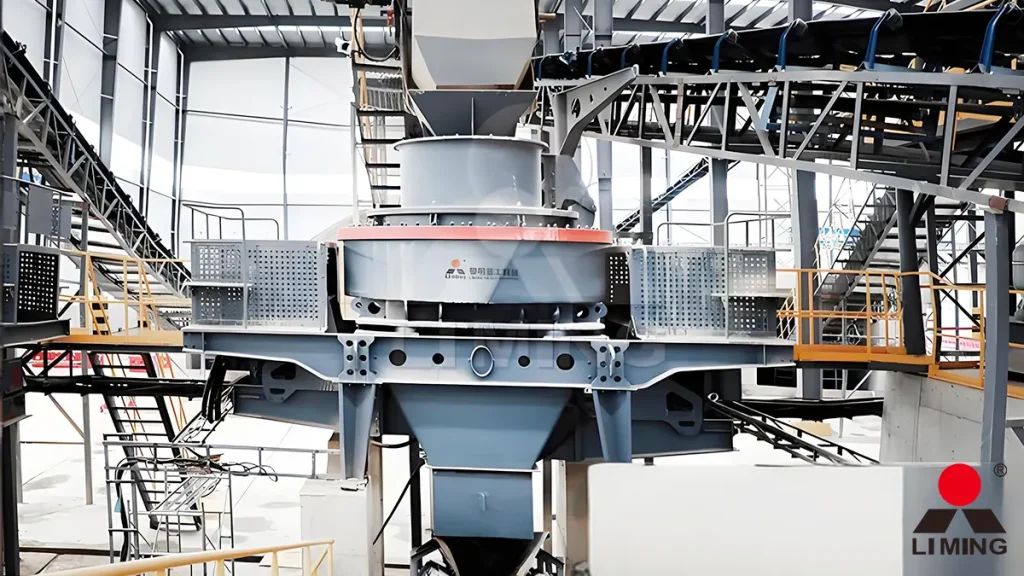
To produce high-quality construction or glass sand, the crushed silica must be shaped to eliminate flat and elongated particles. The material is fed into a Vertical Shaft Impactor (VSI), such as the Liming VSI6X Series Sand Maker. Using a "rock-on-rock" or "rock-on-iron" high-speed centrifugal impact mechanism, the VSI crushes the silica into uniform, cubic sand particles.
2. The Grinding and Scrubbing Circuit
For high-purity industrial applications (like glass manufacturing), crushing alone isn't enough. The silica must be ground to achieve complete physical liberation from gangue minerals (impurities), followed by intense washing to remove surface contaminants.
Wet Rod Milling
Instead of traditional ball mills, silica plants frequently utilize Wet Rod Mills. The steel rods provide a line-contact grinding action, which prevents "over-grinding" and ensures the silica sand maintains a strict, uniform particle size (usually between 40-mesh and 120-mesh). The wet milling process also provides a preliminary scrubbing action, helping to dislodge iron oxide films from the quartz surfaces.
Attrition Scrubbing and Desliming
Once ground, the silica slurry is sent to Attrition Scrubbers. High-speed impellers force the sand particles to violently rub against each other, grinding away stubborn clay coatings and thin-film iron impurities. Following this, the slurry passes through a Desliming Cone (or Hydrocyclone) to wash away the lightweight clay, mud, and slimes, leaving behind a clean quartz sand.
3. The Advanced Beneficiation Circuit (Purification)
To achieve a final product with 99%+ SiO₂ content, the scrubbed silica sand must undergo advanced separation technologies to remove heavy minerals, magnetic iron, and non-magnetic silicates like feldspar and mica.
Gravity Separation
If the silica ore contains heavy mineral impurities like hematite, limonite, or zircon (which have a much higher specific gravity than quartz), gravity separation is employed. The slurry is passed through Spiral Chutes or over Shaking Tables. Centrifugal and gravity forces separate the heavier gangue minerals from the lighter silica sand.
Magnetic Separation
Iron is the ultimate enemy of high-grade silica (especially for glass-making, where iron causes discoloration). The sand is processed through a two-stage magnetic circuit:
- Medium-Intensity Magnetic Separators: Used first to pull out strongly magnetic minerals like magnetite.
- High-Gradient Magnetic Separators (HGMS): Operating at 10,000 Gauss or higher, these machines are essential for removing weakly magnetic impurities such as hematite, biotite, and iron-bearing intergrown particles.
Froth Flotation
If the silica sand still contains significant amounts of feldspar and mica (which are non-magnetic and have a similar specific gravity to quartz), flotation is mandatory. Using a bank of Mechanical Agitation Flotation Cells (e.g., SF or KYF series), the slurry is conditioned in a weakly acidic environment. Specific collectors and frothers are added to selectively float the mica and feldspar, removing them as froth and leaving highly purified quartz in the tailings.
Acid Leaching
For ultra-high-purity applications (like photovoltaic glass or semiconductor silicon), even microscopic iron trapped in the quartz lattice must be removed. The processed sand is soaked in a heated acid bath (usually a mix of hydrochloric, sulfuric, and hydrofluoric acids) to dissolve any remaining metallic impurities.
4. Sizing, Dewatering, and Drying
Once the silica is fully purified, it must be sized, dried, and prepared for final packaging.
- Hindered Settling Classifiers: Used to strictly separate the sand by particle size using upward-flowing water currents, acting as a highly efficient alternative to fine screening.
- High-Frequency Dewatering Screens: The purified wet sand is fed onto high-frequency polyurethane screens to drain the bulk of the water, reducing moisture content to below 15%.
- Rotary Dryers: The damp sand is passed through a heated rotary cylinder to completely remove all moisture.
Finally, the dry, high-purity silica sand is routed to an automated bagging station for packaging into 1-ton or 2-ton bulk bags, ready for market distribution.
Expert Conclusion
Processing silica ore is a highly technical endeavor. Because quartz is so abrasive, utilizing the wrong crushing equipment will result in catastrophic maintenance costs. Furthermore, because the target impurities (iron, feldspar, mica) are often deeply integrated into the ore, relying on a single separation method is rarely sufficient.
To design a profitable silica plant, operators must first conduct a comprehensive mineralogical analysis of their raw ore. By combining robust physical comminution (like the C6X Jaw and HPT Cone Crushers) with optimized grinding, intense magnetic separation, and precise flotation, a processing plant can maximize yield and achieve the ultra-high purity required by today's most lucrative industrial markets.