
Customized Crushing Solution?
Our senior engineers are ready to provide you with tailored configurations and accurate quotes within 24 hours.
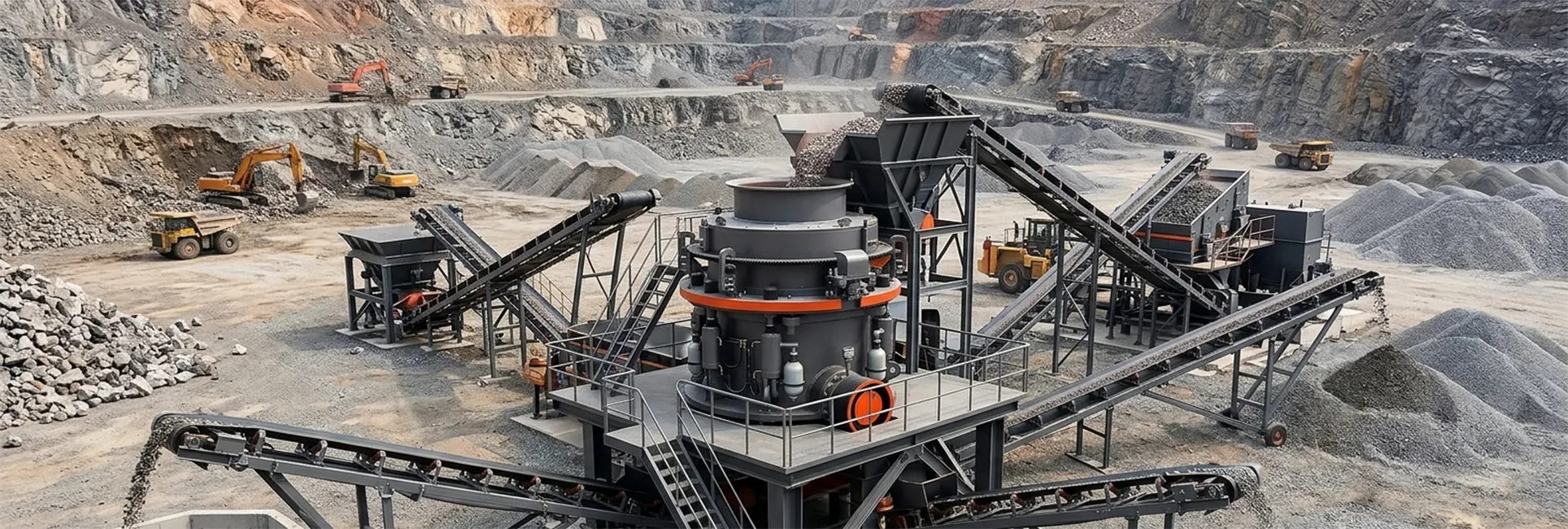
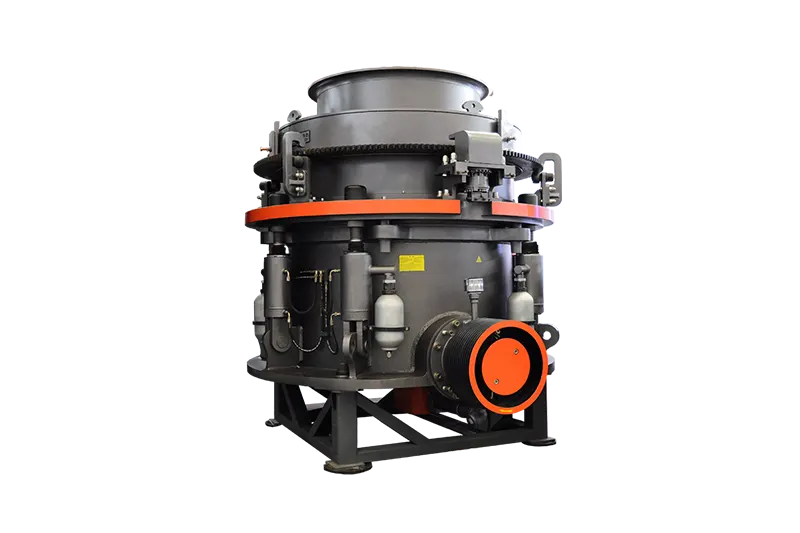
The HPT Series is a high-performance secondary and tertiary crusher engineered around a fixed main shaft and a rotating eccentric sleeve topology. This structural upgrade drastically improves bearing load capacity, allowing the machine to safely accept higher installed motor power. Utilizing inter-particle lamination crushing kinematics, it accepts feed sizes up to 350mm and delivers continuous outputs between 45 to 1200 t/h for medium-hard to extremely hard mineral processing applications.
Engineered for continuous secondary and tertiary size reduction in demanding mineral processing and high-grade commercial aggregate environments.
Processes abrasive river pebbles, granite, and basalt into highly cubical aggregates, minimizing flakiness through inter-particle lamination crushing.
Supplies consistent, standardized fine material feeds required by commercial concrete batching and dry powder mortar plants.
Provides precise size reduction of limestone, dolomite, and quartz sand for power plant flue gas desulfurization systems.
Serves as a reliable secondary or tertiary crushing stage for hard metallic ores, such as gold and iron ore, to optimize downstream milling efficiency.
Built on a foundation where the main shaft is fixed while the eccentric sleeve rotates around it. This optimized mechanical structure allows for higher load-bearing capacity, greater installed power, increased efficiency, and lower operational noise.
Size reduction occurs primarily between the rock particles themselves rather than just against the metal liners. This inter-particle lamination yields exceptional cubic product shapes, high fine-particle content, and lower wear rates on consumables.
The electrical center features a Siemens PLC, touchscreen interface, ABB low-voltage components, and a Siemens high-voltage motor. It offers visual sensor thresholds, configurable alarm protocols, and flexible IoT remote control integration.
The system extends equipment lifespan through automated condition monitoring, including lubrication return oil flow sensors, horizontal shaft speed detection, vibration monitoring, and automated feed control routines.
The unit can be equipped with various medium and fine crushing cavities. By replacing only a small number of components, such as the cavity liners, operators can seamlessly transition between secondary and tertiary processing demands on the same machine.
Manufactured across dozens of CNC production lines. Every step—from steel plate cutting and bending to planing and painting—is digitally controlled, ensuring core components are machined to extremely high tolerances.
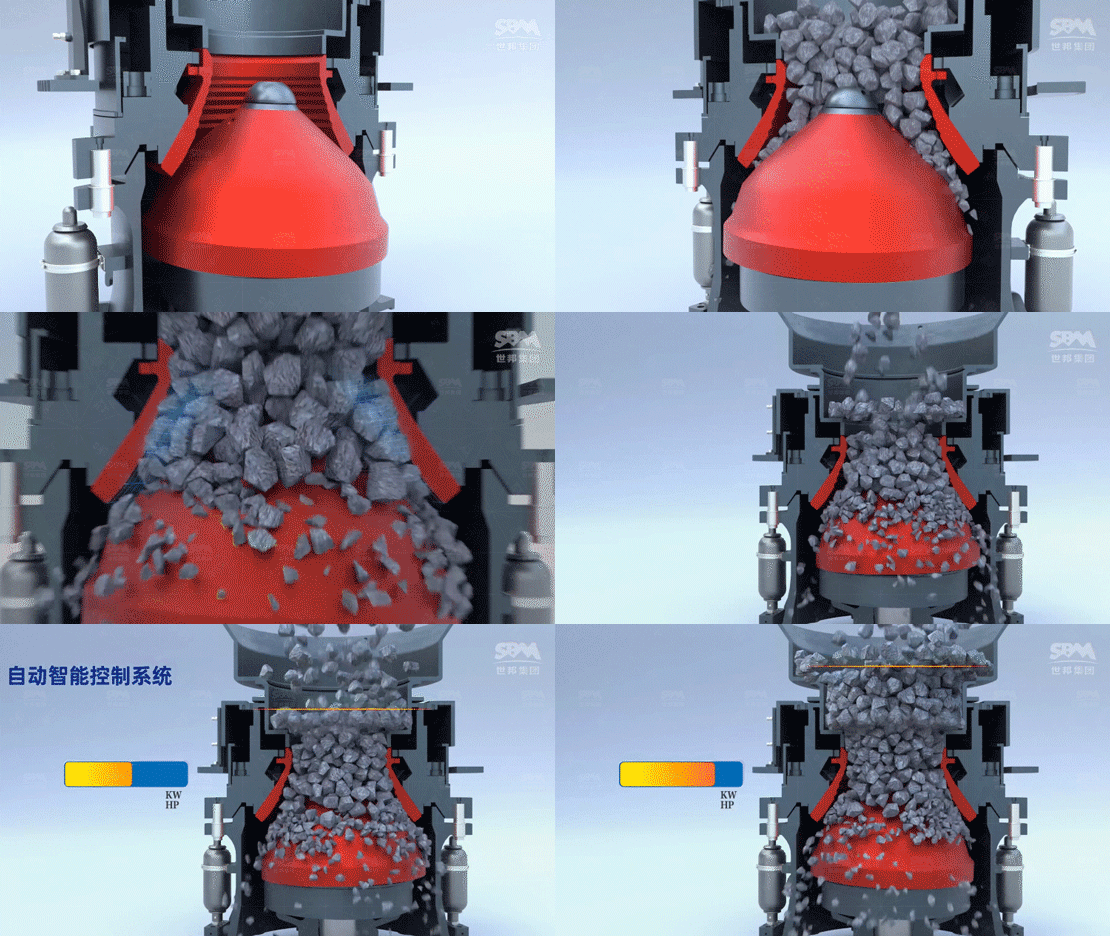
The high-voltage motor transmits rotational torque to the transmission shaft via standard pulleys and V-belts.
The transmission shaft utilizes a pinion and large bevel gear arrangement to drive the eccentric sleeve, forcing it to rotate continuously around the fixed stationary main shaft.
Driven by the eccentric sleeve, the moving cone (mantle) performs a gyratory pendulum motion. This action continuously forces the mantle to approach and retreat from the fixed concave liner (bowl liner).
Material trapped in the crushing cavity is subjected to multidirectional compressive and abrasive forces. Following lamination principles, the rocks crush and grind against each other. Properly sized particles drop through the widening gap, while oversized rocks remain for further reduction.