
If you're running a crushing and screening plant, you know that the vibrating screen is the ultimate gatekeeper of your final product quality. But one of the most common questions plant managers ask is: Exactly how much material can this screen handle per square foot (or square meter) in a 24-hour period?
The capacity per unit area isn't a single static number. It is a highly dynamic metric influenced by the type of equipment you use, the physical dimensions of the screen, and the characteristics of the rock itself—especially moisture.
The Moisture Threshold: Dry vs. Wet Screening
Before looking at the machine, look at your ore. As a general rule of thumb, ordinary ores with a moisture content of up to 10% can be successfully dry-screened down to 10 mesh without requiring pre-drying.
However, if the moisture exceeds that 10% threshold, the fines will become sticky, causing severe blinding (plugging) of the mesh. At this point, you have two choices: either heat the screen mesh electrically (raising the wire temperature to between 100°F and 300°F / 38°C–149°C) to dry the contact point, or switch to wet screening. In a wet vibrating screen setup, you need to maintain a strict water-to-ore ratio of about 3:1 to 3.5:1 to wash the fines through the deck properly.
The 3 Basic Types of Aggregate Screening Equipment
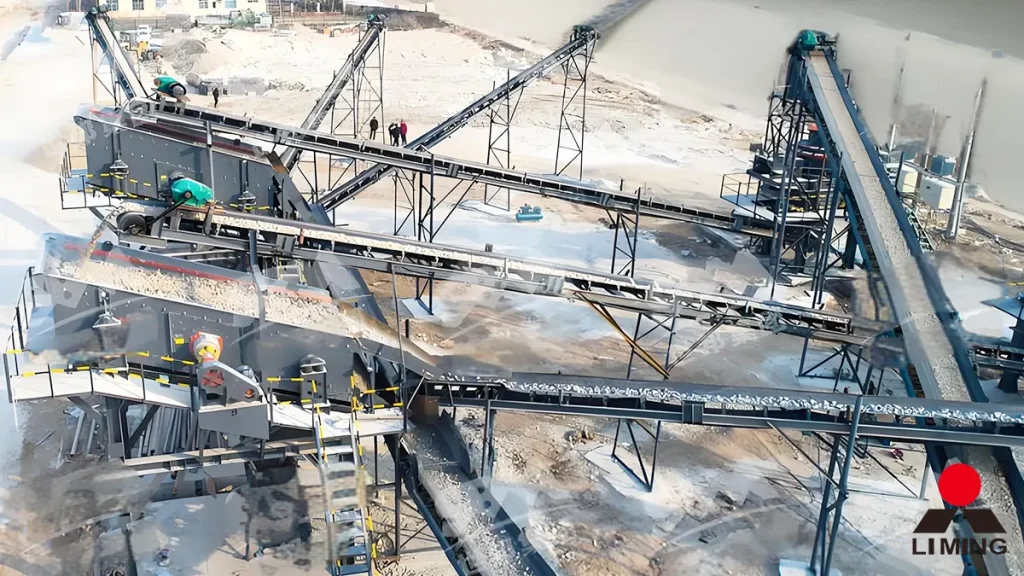
Screening media is typically made from punched steel plates or woven wire mesh, forming square or rectangular apertures. Depending on your capacity goals, you’ll likely use one of these three basic setups:
- Inclined Vibrating Screens: These are flat-deck screens set at a downward angle. An eccentric shaft generates a circular vibrating motion, tossing the material forward and downward. They sit on rubber springs to prevent shaking the entire support structure. (Example: The Liming S5X Series).
- Horizontal Screens: A modern upgrade to traditional shaker screens. They use a linear, reciprocating motion with a high speed and short stroke. They require much less headroom than inclined screens but are rarely used for heavy primary scalping. (Example: The Liming SL Series).
- Trommel (Rotary) Screens: A large perforated cylindrical drum installed almost horizontally. As it slowly rotates, material tumbles inside. The holes can gradually increase in size down the length of the drum to separate different fractions. When calculating a trommel's capacity, engineers usually use one-third of the drum’s diameter multiplied by its length as the "effective screening area."
Multi-Deck Configurations for Maximum Capacity
To drastically increase screening capacity without taking up a massive footprint, flat vibrating screens are designed with multiple parallel decks.
In high-capacity aggregate plants, you might see a "two-and-a-half deck" setup on mobile units. The spacing between these layers is critical; there must be enough room for the material to stratify. The oversized rock retained on the top deck is sent back to the primary crusher. Material passing the top but caught on the second goes to the secondary crusher. Finally, material passing the second deck is graded into final products, with excess dust or fine sand removed by the bottom half-deck.
Key Factors Determining Vibrating Screen Capacity
So, what actually dictates the exact tonnage a screen can handle per square meter? While some outdated literature might cite capacities as low as "4 to 5 tons," heavy-duty mining screens handle exponentially more. For instance, high-end models like the Liming S5X3680-3T can comfortably process anywhere from 225 to 2250 tons per hour depending on the mesh.
Here are the structural parameters that dictate this performance:
1. Screen Width vs. Screen Length
This is the golden rule of screening: Width determines capacity; Length determines efficiency.
- Width: The wider the screen, the thinner the material bed depth, allowing more tonnage to pass over it quickly. Historically, width was limited by the structural integrity of the frame. While standard screens often tap out around 2.5 meters wide, advanced engineering now allows for massive widths. For example, Liming's S5X series reaches up to 3.6 meters wide (S5X3680) to handle massive feed flows.
- Length: A longer screen gives particles more chances to find a hole and drop through (increasing efficiency). However, after a certain point, making a screen longer doesn't improve efficiency enough to justify the extra weight and power draw. A standard length-to-width ratio for mining screens is 2:1, while coal screens often use 2.5:1.
2. Screen Inclination Angle
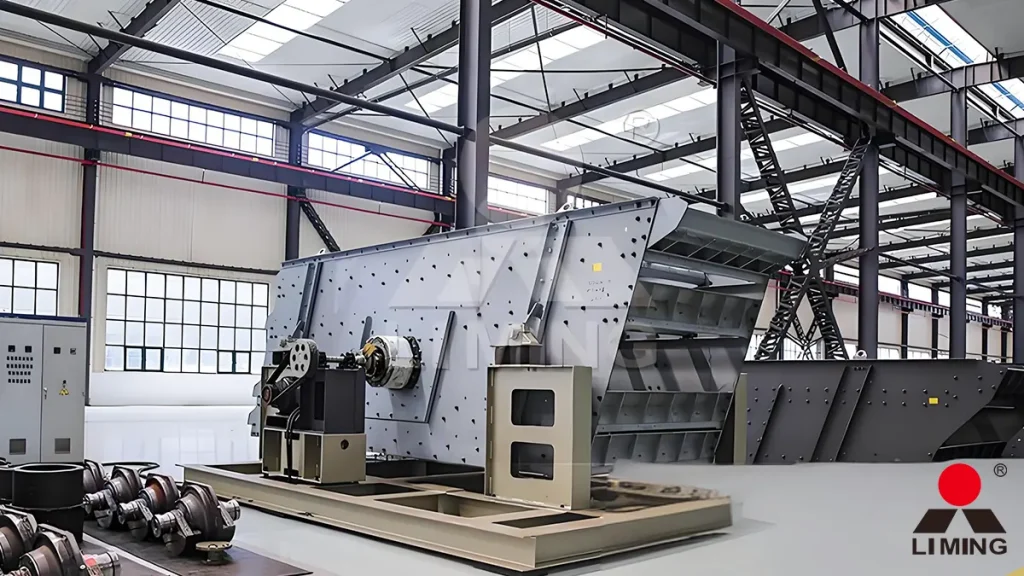
The installation angle drastically affects both throughput and accuracy. A steeper angle means gravity pulls the rock down the deck faster. This increases your capacity (throughput) but decreases the time the rock spends on the screen, which lowers your screening efficiency because particles have fewer chances to pass through the mesh.
3. Aperture Size, Shape, and Open Area Rate
The larger the screen hole, the higher the capacity per unit area.
- Aperture Size: For standard sizing, the mesh opening usually matches the desired product size. However, if you need a very fine product, the hole is sometimes sized slightly larger than the target. For rough scalping, the holes are significantly larger.
- Shape: Round and square holes yield a very accurately shaped under-size product. However, if your rock is flaky or damp, it will plug square holes. In these cases, rectangular/slotted holes are used. By aligning the long side of the slot with the flow of material, you reduce flow resistance and minimize blinding.
- Open Area Rate: This is the percentage of the screen deck that is actually "open space" versus wire/steel. A higher open area rate means better capacity and efficiency. The trade-off? Thinner wires mean a higher open area but a shorter wear life for the mesh.
Getting the Right Screen for Your Operation
Calculating the exact capacity per unit area for a vibrating screen is highly complex. It depends heavily on your specific aggregate, feed gradation, moisture content, and target sizes.
Instead of guessing, let the experts map it out. Whether you need a massive 3-layer S5X3075 inclined screen for raw aggregate or an SL3061H linear screen for precise grading, contact us today. We will run the capacity calculations based on your actual site data to ensure your plant never experiences a bottleneck.