
If you've spent any time running an aggregate plant or a mining operation, you know that medium-to-hard rocks (like granite, basalt, and river pebbles) require serious crushing power. That’s exactly where the Hydraulic Cone Crusher steps in.
By utilizing advanced hydraulic systems to adjust the discharge opening, clear the crushing cavity, and provide tramp-iron overload protection, these machines have revolutionized secondary and tertiary crushing. They are safer, more efficient, and produce a much better particle shape than older spring-based models.
Let's dive into the two main categories of hydraulic cone crushers—Single-Cylinder and Multi-Cylinder—and break down how they work, their specs, and their costs.
1. Hydraulic Cone Crusher Types & Technical Parameters
To meet diverse production demands, Liming Heavy Industry has engineered two distinct lines of hydraulic cone crushers. Depending on your feed size and whether you need coarse, medium, or fine crushing, you can select from different cavity types (such as S1-H3 for single-cylinder, and C1-F2 for multi-cylinder).
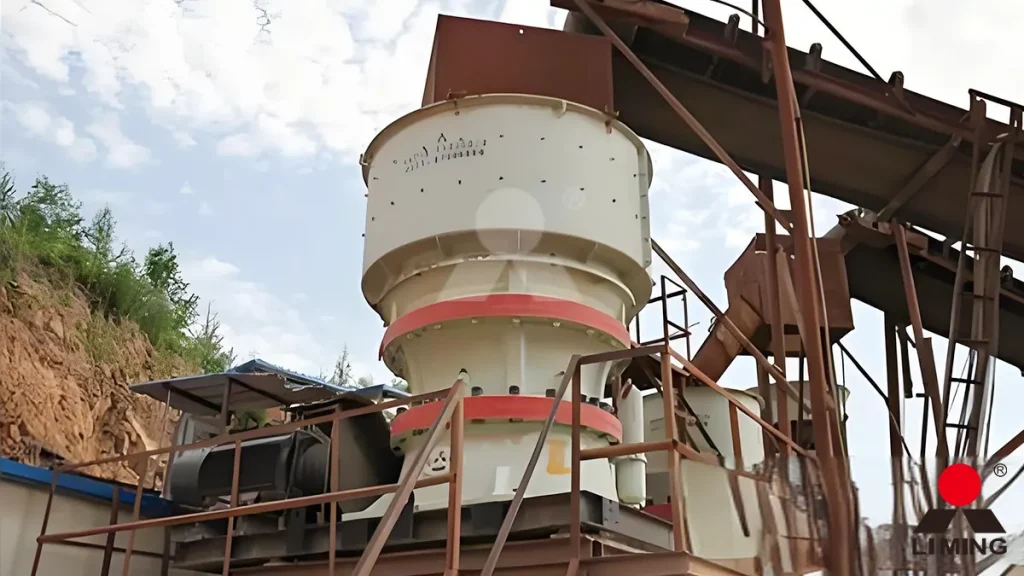
The HST Single-Cylinder Hydraulic Cone Crusher
The HST series is a marvel of modern engineering. It uses a single, heavy-duty hydraulic cylinder located at the bottom of the main shaft. This single cylinder controls the up-and-down movement of the cone, handling the discharge adjustment, cavity clearing, and overload protection all at once.
Key Advantages: It features a constant crushing cavity design, meaning the wear on the liner is incredibly uniform. Plus, the mantle and bowl liner don't require epoxy backing compound, making part replacements incredibly fast. It is fully integrated with modern IoT (Internet of Things) platforms for remote monitoring.
| Model | Max Feed Size (mm) | Capacity (t/h) | Motor Power (kW) | Cavity Options |
|---|---|---|---|---|
| HST100 | 240 | 27 - 170 | 90 | S1-H3 |
| HST160 | 360 | 48 - 345 | 160 | S1-H3 |
| HST250 | 450 | 90 - 605 | 250 | S1-H3 |
| HST315 | 560 | 170 - 1050 | 315 | S1-H3 |
| HST450 | 560 | 500 - 1300 | 450 | S1-H2 |
| HST560 | 300 | 270 - 1515 | 560 | H1-H3 |
| HST750 | 370 | 350 - 2130 | 750 | H1-H3 |
The HPT Multi-Cylinder Hydraulic Cone Crusher
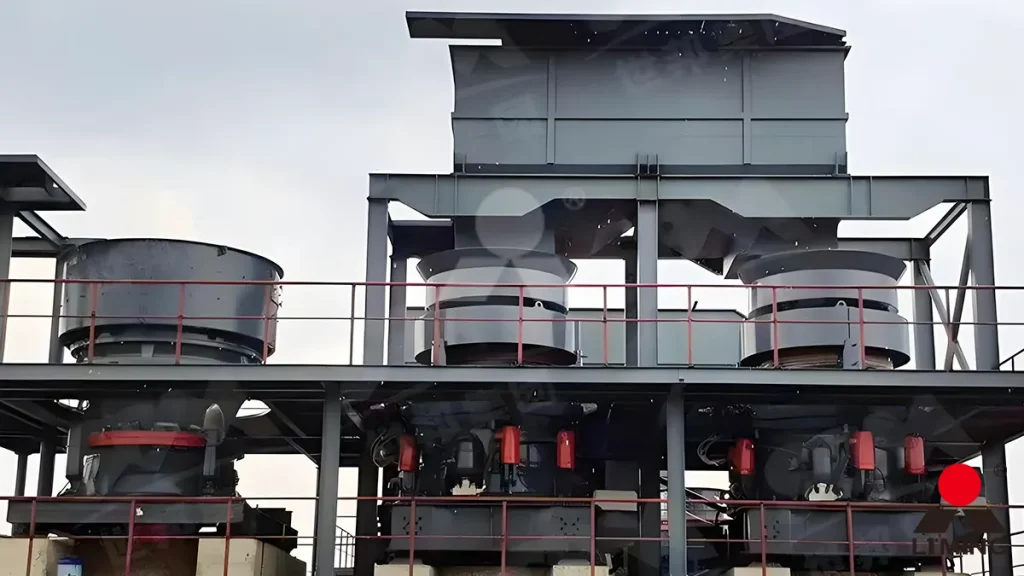
If your end-users demand perfect, cubic-shaped aggregates, the HPT series is what you need. It relies on multiple hydraulic cylinders arrayed around the machine for locking, protection, and clearing.
Key Advantages: The HPT uses an advanced "lamination crushing" principle. By optimizing the eccentric distance and running at a specific speed, the rocks crush against each other rather than just against the steel liners. This drastically improves the particle shape (reducing flat and elongated stones) and increases your overall output.
| Model | Max Feed Size (mm) | Capacity (t/h) | Motor Power (kW) | Cavity Options |
|---|---|---|---|---|
| HPT100 | 140 | 45 - 140 | 90 | C1-C2 |
| HPT200 | 185 | 90 - 250 | 160 | C2-F2 |
| HPT300 | 230 | 110 - 440 | 250 | C1-F2 |
| HPT400 | 295 | 135 - 630 | 315 | C1-F2 |
| HPT500 | 330 | 220 - 790 | 400 | C1-F2 |
| HPT800 | 350 | 310 - 1200 | 630 | C1-F2 |
2. How Does a Hydraulic Cone Crusher Work?
While watching a video of the internal mechanics is always helpful, the physical principle is actually quite straightforward.
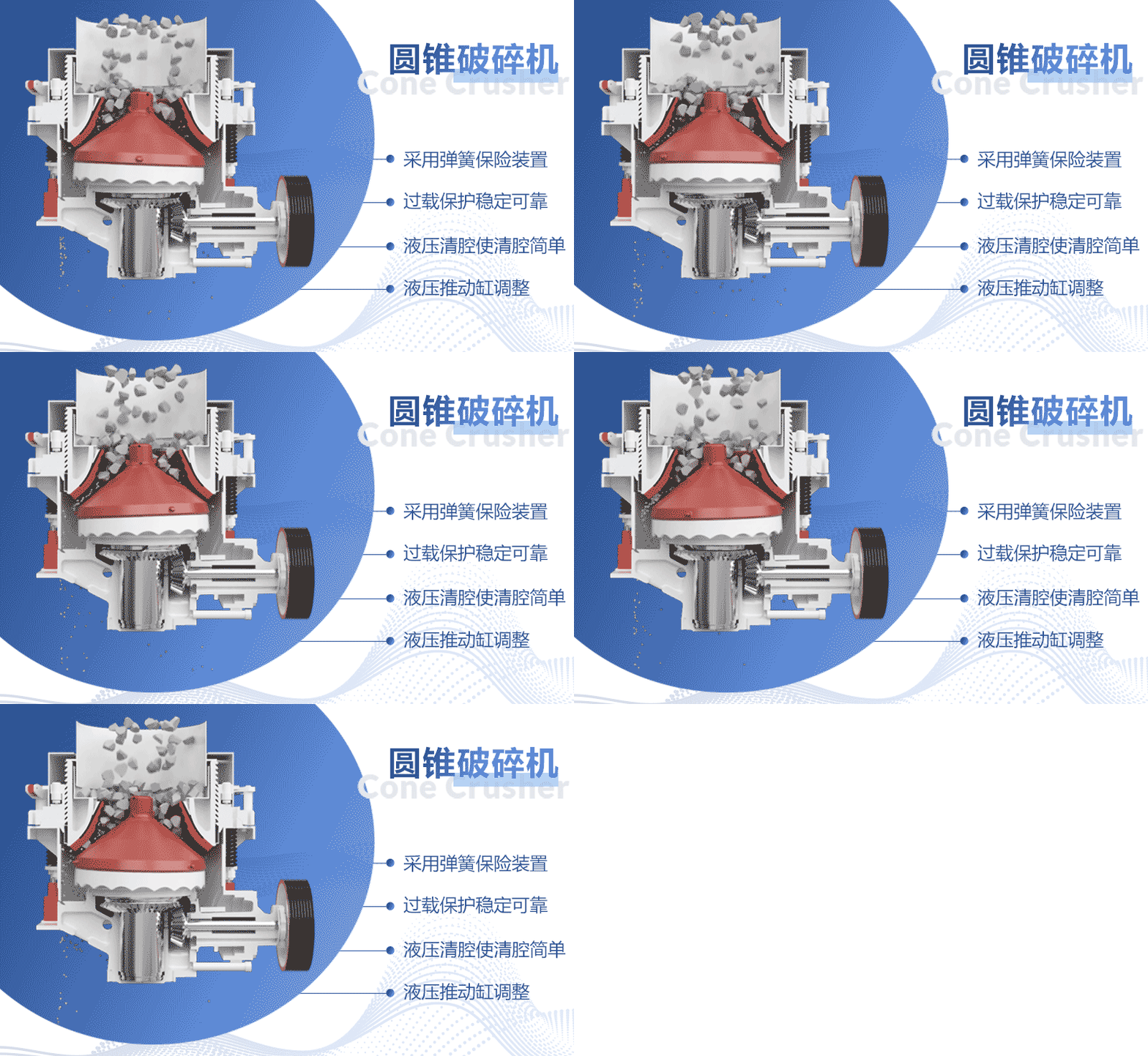
During operation, the electric motor drives a pulley or coupling, which spins the transmission shaft. This shaft forces the eccentric sleeve to rotate. As the eccentric sleeve turns, it forces the crushing mantle (the moving cone) to swing in a circular, pendulum-like motion.
Because of this swinging motion, the moving mantle constantly approaches and then retreats from the fixed bowl liner. When the rock falls into the crushing cavity, it gets trapped between these two surfaces and is violently squeezed, bent, and crushed. The crushed rock then falls through the bottom discharge opening.
Real-World 300 TPH Plant Layout Example:
- Max Feed: ≤ 500mm
- Final Output Sizes: 0-5mm, 5-10mm, 10-15mm, 15-30mm
- Process Flow: Vibrating Feeder → Primary Jaw Crusher → HPT/HST Hydraulic Cone Crusher → Vibrating Screen → Belt Conveyors.
3. How Much Does a Hydraulic Cone Crusher Cost?
Pricing for hydraulic cone crushers is not a one-size-fits-all number. Depending on the size of the machine and the technology packed into it, prices generally range from tens of thousands to over a million dollars (USD).
The final price tag is heavily influenced by:
- Model and Capacity: A compact HST100 (170 t/h max) is a fraction of the cost of a massive HST750 (2130 t/h max).
- Technology Type: Multi-cylinder (HPT) models often have a different pricing structure than single-cylinder (HST) models due to the complexity of the hydraulic and control systems.
- Manufacturer & Quality: Top-tier manufacturers use high-grade steel alloys and precision automation (PLC systems), which cost more upfront but prevent catastrophic downtime in the future.
For over 40 years, Liming Heavy Industry has strictly controlled our raw materials and manufacturing processes to deliver world-class crushers. Because we sell directly from our own factory, you avoid the heavy markups charged by third-party dealers.
If you need exact pricing for a hydraulic cone crusher tailored to your specific rock type and capacity, simply reach out to us online. Our dedicated product managers will provide a one-on-one consultation and a precise factory-direct quote.