
If you're in the aggregate business, you already know that quality stone materials—natural rocks, pebbles, or mine tailings crushed and screened into particles larger than 4.75mm—are the absolute backbone of modern construction, roads, and bridges. But how exactly do you get from raw rock to high-grade aggregate? That’s where a dedicated stone crushing plant comes in.
Today, I want to walk you through the practical side of designing a 200 tons per hour (t/h) stone crushing line. We’ll look at the typical process flow, real-world equipment configurations based on different rock types, and what you should expect to budget for the whole setup.
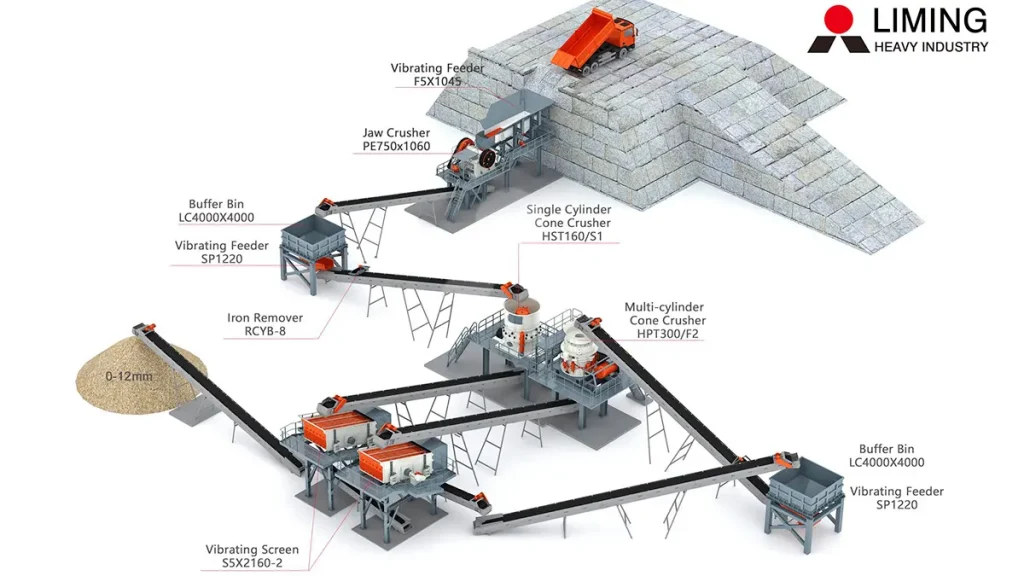
The Standard Process Flow of a 200 T/H Crushing Plant
With so many types of mining machinery on the market, figuring out the right combination can be a headache. Usually, it's best to let an experienced manufacturer design the layout based on your raw material hardness, capacity goals, budget, and site constraints. However, almost every solid 200 t/h aggregate plant follows a core sequence:
General Workflow: Vibrating Feeder → Jaw Crusher → Impact Crusher (or Cone Crusher) → Vibrating Screen → Belt Conveyors.
- Feeding: Dump trucks unload the raw rocks into the hopper, which channels them into the vibrating feeder.
- Primary Crushing (Coarse): The feeder steadily drops the materials into the jaw crusher. This machine handles the big chunks, breaking them down to a size manageable for the next stage.
- Secondary Crushing (Fine/Medium): A belt conveyor transports the coarsely crushed stones to either an impact crusher (great for softer rock) or a cone crusher (the go-to for hard rock) to shape them into the final desired sizes.
- Screening: The crushed output is conveyed to a vibrating screen. This separates the stones into different piles based on your specific requirements. Anything too big is looped back to the secondary crusher for another pass.
Real-World Equipment Configurations (Client Case Studies)
At Liming Heavy Industry, we’ve been designing and manufacturing crushing equipment for 40 years. We’ve built tens of thousands of eco-friendly production lines globally. To give you a better idea of how this looks in practice, let’s dive into two active client sites. (Note: Equipment specs have been adjusted to reflect our current optimized database for a true 200 t/h output).
Case 1: Limestone Crushing Plant in Hebei
This project was commissioned a few years ago specifically to process limestone, a relatively soft and medium-hard rock. The goal was high yield and excellent particle shape.
- Raw Material: Limestone
- Max Feed Size: ≤ 600mm
- Final Products: 0-5mm, 10-20mm, 20-30mm aggregates (commonly known as 05, 12, and 13 stones).
| Equipment Type | Recommended Model | Max Feed Size (mm) | Power (kW) |
|---|---|---|---|
| Vibrating Feeder | GZD-1100×4200 | 600 | 15 |
| Jaw Crusher | PE750×1060 | 630 | 110 |
| Impact Crusher | PF1315 | 300 | 200 |
| Vibrating Screen | 4YZS2160 | 100 | 30 |
Why this setup works: We went with a Jaw + Impact Crusher combo. Since limestone isn't overly abrasive, the impact crusher can easily handle the secondary stage, producing beautifully cubic stones with very little rock powder waste. This "crush more, grind less" philosophy keeps operational costs low and shortens the ROI cycle.
Case 2: Granite Crushing Plant in Guangdong
Granite is a completely different beast compared to limestone. It's incredibly hard and abrasive. Using an impact crusher here would mean replacing wear parts constantly, which destroys profitability. Here is how we tackled it:
- Raw Material: Granite
- Max Feed Size: ≤ 500mm
- Final Products: 10-20mm, 20-30mm aggregates.
| Equipment Type | Recommended Model | Max Feed Size (mm) | Power (kW) |
|---|---|---|---|
| Vibrating Feeder | TSW0936 | 500 | 15 |
| Jaw Crusher | C6X110 | 720 | 160 |
| Cone Crusher | HPT200 | 185 | 160 |
| Vibrating Screen | 3YZS1860 | 100 | 22 |
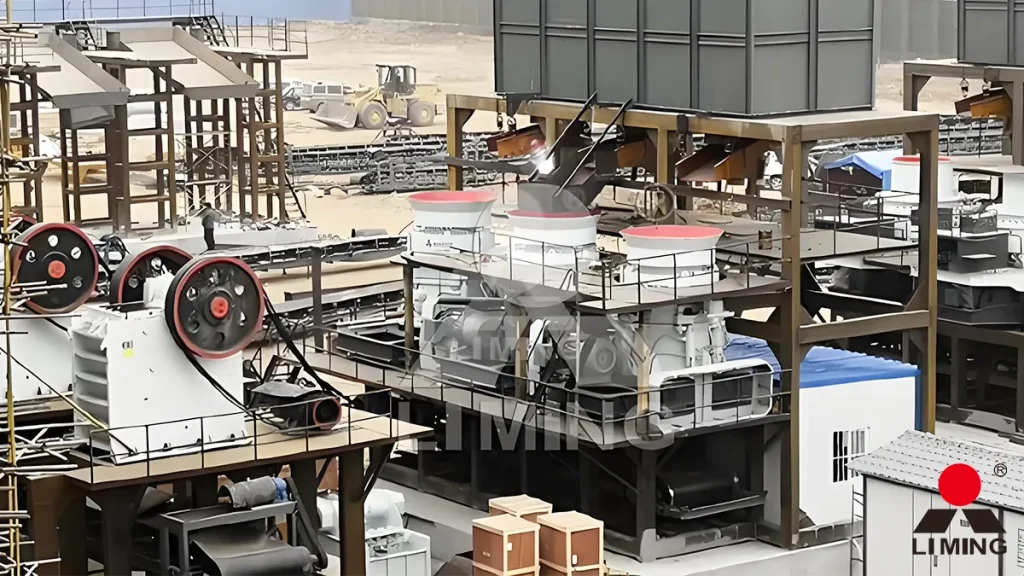
Why this setup works: For hard rocks, the Jaw + Cone Crusher configuration is mandatory. The HPT200 Cone Crusher uses lamination crushing, which significantly extends the life of the mantle and bowl liner. Plus, this specific client opted for our fully automated smart control system. Having a remote touchscreen interface cut down their manual labor needs and made the whole plant much safer to operate.
So, What Does a 200 T/H Crushing Plant Cost?
Let's talk numbers. Because 200 tons per hour is a very standard mid-range capacity, the market is competitive. Depending on the exact machines you choose, a complete line will generally run anywhere from several hundred thousand to over a million RMB (or roughly $100,000 to $300,000+ USD, depending on exchange rates and specific tech add-ons).
The final price tag fluctuates based on:
- Equipment Configuration: A cone crusher setup for granite will typically cost more upfront than an impact crusher setup for limestone, though it saves money long-term on maintenance.
- Design Complexity: Do you need extensive dust-collection systems or smart PLC controls?
- The Manufacturer: Choosing a direct factory supplier versus a middleman makes a huge difference.
At Liming Heavy Industry, we don't just sell machines. Our pricing includes full-service support: site planning, infrastructure assistance, installation, debugging, and operator training. Because we supply directly from our own factory, we can offer aggressive factory-direct pricing.
If you're looking into starting a project, feel free to reach out to us with your material type and site location, and we'll gladly put together a customized layout and exact quote for you.