
If you're in the mining or aggregate business, you're likely no stranger to quartz sand. Composed primarily of silica, quartz is a foundational material used across multiple high-demand industries, from glass manufacturing and ceramics to metallurgy, chemicals, and high-end construction materials.
But here is the catch: quartz is an extremely hard, highly abrasive non-metallic mineral. Sitting at a 7 on the Mohs hardness scale with a density of 2.65, it will absolutely shred the wrong type of crushing equipment. If you try to process quartz with standard impact crushers, your wear parts will vanish overnight, taking your profit margins with them.
So, what equipment do you actually need to reliably crush quartz rock into premium 0.25-0.5mm sand? Let’s dive into the best machinery for the job and look at a realistic 200 tons-per-hour (t/h) setup.
The Core Equipment for Crushing Quartz Sand
Because of its abrasive nature, processing quartz strictly requires a "hard rock" configuration. This means relying on compression crushing for the primary and secondary stages, and specialized impact technology for the final sand shaping.
1. The Jaw Crusher (Primary Crushing)
Every heavy-duty quartz line starts with a jaw crusher. Designed to handle large boulders, jaw crushers use a squeezing action rather than impact. Modern units feature a deep, "V-shaped" crushing cavity that ensures large rocks don't get stuck, keeping your throughput high.
Today’s premium models also feature hydraulic or wedge discharge adjustments, allowing operators to change the output size in minutes. Features like integrated motor mounts and precision-engineered flywheels also drastically reduce vibration, making the machine incredibly stable.
2. The Cone Crusher (Secondary Crushing)
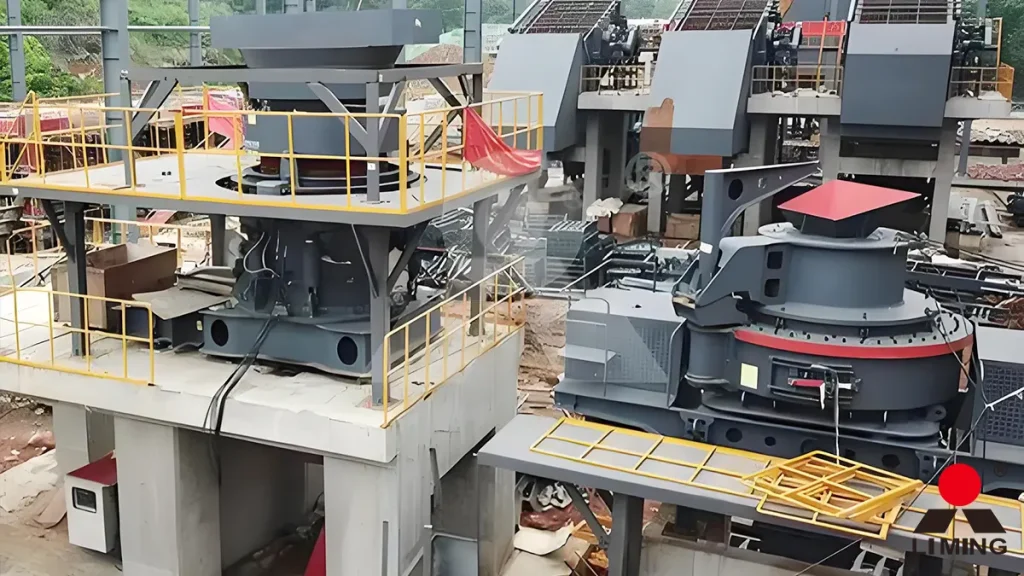
You cannot skip the cone crusher when dealing with silica. Acting as the secondary crusher, the cone crusher works by squeezing the rock between a moving mantle and a fixed bowl liner (lamination crushing). It delivers massive crushing force with high efficiency.
High-end cone crushers allow you to swap out different cavity types based on your exact needs, adjusting the discharge opening hydraulically to maintain uniform particle sizes. They are highly wear-resistant and feature advanced overload protection to prevent uncrushable materials (like tramp iron) from damaging the machine.
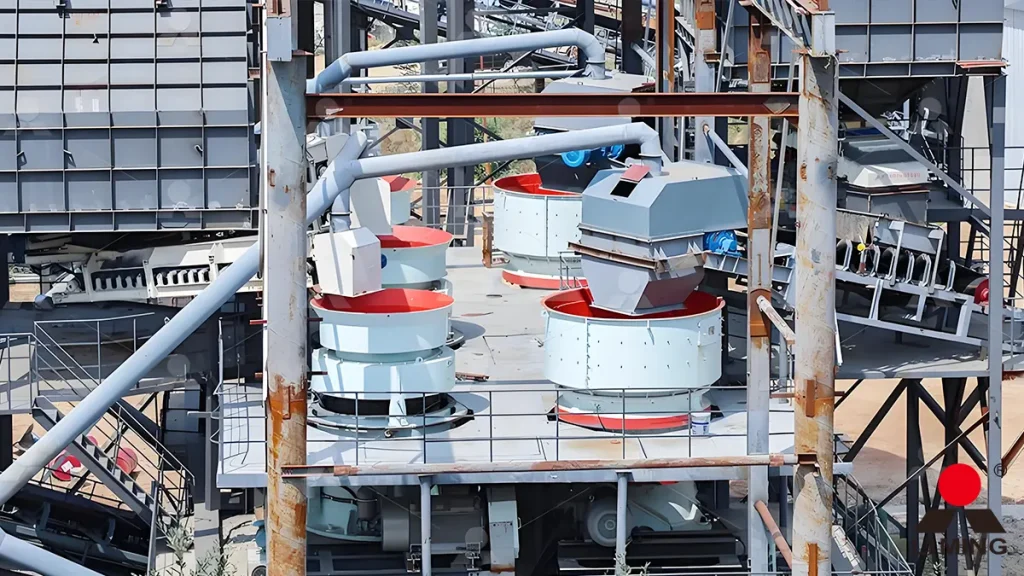
3. The VSI Sand Maker (Fine Crushing & Shaping)
To turn crushed quartz into actual sand, you need a Vertical Shaft Impactor (VSI). This is where the magic happens. VSI machines use a "rock-on-rock" and "rock-on-iron" principle. The machine flings the quartz at high speeds using a specialized rotor, causing the stones to smash against each other and the crushing chamber.
Top-tier sand makers feature a 4-port impeller design that increases throughput, along with reversible perimeter guard plates to double their lifespan. The result is perfectly shaped, highly cubic quartz sand with zero jagged edges.
Optimal 200 T/H Quartz Sand Process Flow
To give you a real-world perspective, here is exactly how we configure a 200 t/h quartz sand production line to handle feed sizes up to 500mm, producing fine 0.25-0.5mm sand.
The Workflow:
Vibrating Feeder → Jaw Crusher → Cone Crusher → VSI Sand Maker → Vibrating Screen → Sand Washer → Belt Conveyors.
Recommended Equipment Setup (Liming DB Specs):
- Feeder: TSW0936 (Handles up to 500mm rocks smoothly).
- Primary Crusher: C6X100 Jaw Crusher (High-efficiency premium jaw, 110kW).
- Secondary Crusher: HPT300 Cone Crusher (Multi-cylinder, built for extreme hardness).
- Sand Maker: VSI6X9026 (Produces perfect cubic sand, 2x132kW power).
- Screening: S5X2460-3 Vibrating Screen (Separates exact sand specifications).
- Washing: 2XL915 Wheel Sand Washer (Cleans out impurities and rock powder).
How Much Does Quartz Sand Making Equipment Cost?
Because quartz processing requires specialized, heavy-duty machinery, the investment is higher than a standard limestone plant. For a complete, commercial-scale 200 t/h system, total costs typically range from the low hundreds of thousands to over a million dollars (USD).
The price fluctuation depends heavily on a few key factors:
- Equipment Tiers: Choosing standard models (like PE jaw crushers) will save money upfront, while premium models (like the C6X jaw and HPT cone) cost more initially but drastically lower operational and maintenance costs over time.
- Configuration Complexity: Do you need extensive washing systems? What about environmental dust suppression or smart PLC control panels? These add to the bottom line but are often required by local regulations.
- Manufacturer Selection: The market is flooded with equipment suppliers of varying quality. Buying direct from a reputable manufacturer with proven R&D and solid after-sales support ensures you aren't overpaying a middleman or buying machines that will break down under the stress of crushing quartz.
If you're ready to get exact numbers for your site, the best next step is to request a tailored quote. Provide your target capacity and max feed size, and our engineers can design a custom quartz crushing layout to maximize your profitability.